Strength in Numbers

After long hoping that piracy figures would fall thanks to measures taken individually by studios or countries, audiovisual players must face the facts: illegal downloading is not decreasing, and its structure keeps changing. Staying isolated therefore does not allow effective measures to be taken. That is why studios and international authorities have begun to form coalitions and alliances, permanent or occasional, in order to carry out more effective joint actions. We will present some of these joint actions in this article.
The MPA and ACE
The Motion Picture Association (MPA) is an American trade association representing the five major film studios of the United States, as well as the video streaming service Netflix. Founded in 1922, the association's initial goal was to ensure the viability of the American film industry. The MPA gradually broadened its work and began to defend the interests of the film and television industry in the broad sense, notably aiming to promote effective copyright protection, and therefore to fight piracy.
In the spring of 2022, the MPA explicitly asked the European Union for help in its fight against piracy. Their request is based on the report it publishes every year and on a similar report published by the EU. The MPA's recommendations are aimed particularly at foreign authorities, to help them take measures that the United States cannot adopt for lack of jurisdiction.
AgencePDN gets pirated content removed: see our solutions by sector.
The MPA's idea is therefore to call on the Commission to pool known information and resources, in order to fight certain players that, through their size, their complexity and the multiplicity of jurisdictions in which action would be needed to be effective, hold back the fight against piracy.

The MPA's offices, a tribute to cinema
The MPA notably draws the attention of European authorities to the following points:
- Platforms should take proactive measures to prevent the availability of illicit content
- Platforms should have a clear obligation to verify the identity of all their business customers and to ensure that the contact details listed are up to date and accurate (online transparency)
- Intermediaries should take adequate measures to ensure that their services are not used to facilitate infringement, by ceasing to provide their services (access, hosting, search, ads, domain names, proxies, etc.) to illicit services or to services that have not met verification requirements.
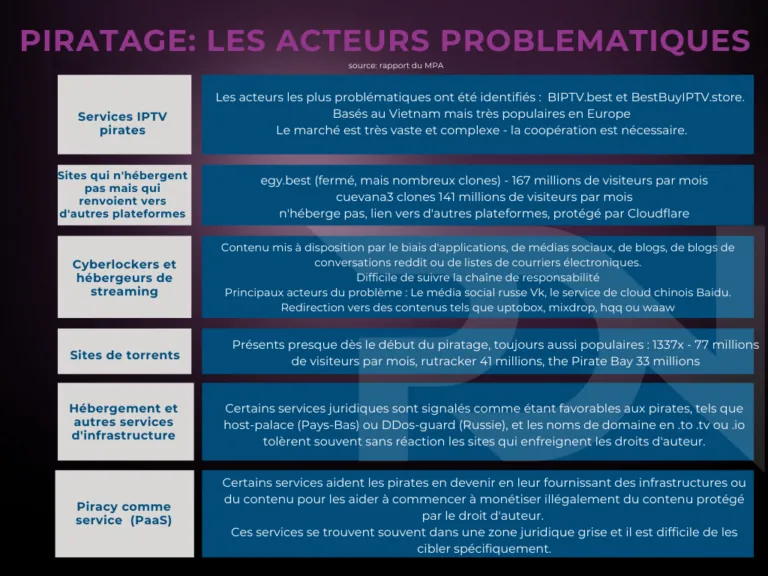
The report also notes the particular threat of illegal IPTV. According to the MPA, the technical infrastructure of these services is often “vast and complex,” which makes it extremely difficult to identify the sources of content and the service operators. These services also keep a number of other illegal businesses alive, notably subscription resellers, infrastructure providers, hosting services and so on.
VK and Baidu: insufficient progress
One of the most problematic sites when it comes to sharing illicit content is the Russian social media site vk.com, even though the site has already taken some measures and responds well to takedown notices. The report nevertheless stresses that the social network could be much more proactive. Likewise, the Chinese cloud service Baidu Pan is at the heart of the problem; slow takedowns and the lack of filtering were highlighted in the MPA's report as well as in the European Union's. By joining forces, the United States and Europe would have enough weight to put pressure on this kind of international company.
The effectiveness of alliances
The effectiveness of these larger entities has already been demonstrated several times.
The MPA was notably behind the shutdown of the huge link directory Egy.best. For its part, a coalition related to the MPA, the Alliance for Creativity and Entertainment (ACE), was, as early as 2019, one of the main players leading to the shutdown of the sites Openload and Streamango.
A stronger worldwide presence
But Europe and the United States, although covering a large part of the market, represent by no means all, or even the majority, of pirate sites.
That is why in April 2022 ACE welcomed beIN Sports into its ranks, and then, in June, the association expanded into Asia with two additional members – Viu, a Hong Kong-based streaming platform, and True Visions, Thailand's leading cable and satellite television provider, in order to strengthen the association's worldwide presence.
The video streaming platform Viu, based in Hong Kong, is available in seven Asian markets, including Hong Kong, Singapore, Malaysia, Indonesia, the Philippines, Thailand and Myanmar. The platform also offers an ad-supported service and a premium service, and produces its own content under its “Viu Original” brand.
True Visions is Thailand's leading cable and satellite television provider. In 2020, it teamed up with the MPA to shut down three pirate streaming sites. More recently, it collaborated with ACE to shut down We-Play, one of Thailand's largest piracy portals.
With the arrival of these three new major players, ACE now has 39 members.
In the age of globalization, anti-piracy players must also think globally, and join forces to fight better. This does not make individual actions useless, but they seem less and less sufficient in a digital world in permanent flux.
Don't hesitate to contact us if you need a cybersecurity professional to shed light on these issues; we are committed to offering you concrete, effective solutions.
Join us on October 1 for our new article, in which we will look at PaaS (piracy as a service), or when pirates offer to train and provide infrastructure to those who aspire to get into this illegal trade.