Ebooks and Piracy: How to Respond?

In our last article, we discussed ebook piracy and, more specifically, how widespread it is among students. This time, we will try to understand its real impact, but above all to analyze whether it is possible to fight the resulting loss of revenue. Indeed, while music, films and games have all seen an overall decline in piracy and download rates in recent years, ebook piracy has increased as never before.
There are several ways to protect and defend your content: technical means such as DRM, legal means, and what we can call proactive means – searching for content that infringes copyright and requesting its removal.
The (Limited) Effectiveness of DRM
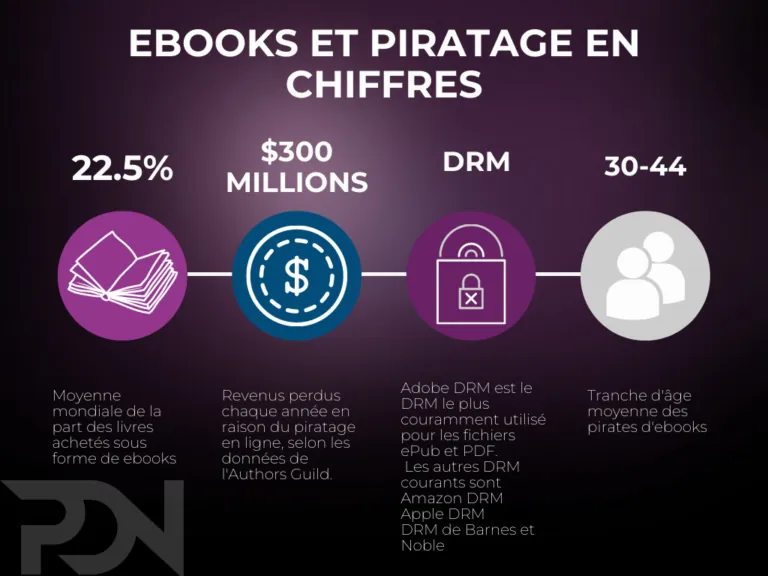
In principle, DRM protection software ensures that your ebooks are protected against any unauthorized use and abuse. It is a data encryption method that prevents any user without the appropriate access key from accessing the content.
AgencePDN gets this kind of content removed: see our Books and publishing service.
Most online bookstores use DRM and watermarking to ensure that only the original buyer can open the file. Watermarking is a visible or invisible mark embedded in the ebook's code at the time of the transaction. It includes the buyer's personal data, such as their name, email address and sometimes the publisher's or author's contact details.
This technique is meant to prevent the distribution of the protected content since the buyer's details are embedded in the ebook. In the event of an infringement, publishers can therefore easily trace and take action against the person who illegally distributed the protected content.
In reality, however, a few minutes are enough for someone with some technical knowledge and the right tools to remove these protections and easily make a PDF, MOBI or EPUB copy of the ebook they want to pirate. DRM can therefore prevent some piracy, serving as a first filter for users with little technical knowledge, but it is far from absolute security.
The Grisham / Amazon / Penguin Random House Case: A Clear Message for Pirates
Some authors are no longer putting up with it. Amazon Content Services, Penguin Random House and a group of Authors Guild members, including American author John Grisham and British writer Lee Child, filed a lawsuit in a Washington State court against the Kiss Library site. The site, hosted in Ukraine, sold pirated digital books at low prices, obviously without having acquired the rights and therefore without paying anything to the authors and rights holders.
In July 2020, a temporary restraining order was in fact filed against Ukrainian nationals Rodion Vynnychenko and Artem Besshapochny, with no response from them. The order aimed to curb the activities of the targeted sites: online payment sites, internet service providers and domain name providers, advertisers and search engines were prohibited from working with the targeted sites and individuals. The Court recognized the plaintiffs' right to obtain the maximum damages, $150,000 per identified work. Added up, the amount of the judgment comes to $7.8 million.

Doug Preston, journalist, writer and president of the Authors Guild, said the lawsuit was filed “not only on behalf of ourselves but for the thousands of authors who labor years to write a book, putting their hearts and souls into every sentence, only to see their income lost to book piracy.”
Mary Rasenberger, CEO of the Guild, also said in a statement that authors rarely have the resources needed to fight commercial-scale piracy and engage in prolonged litigation, and that the Guild is extremely grateful to Amazon Publishing and Penguin Random House for their collaboration in this action.
Indeed, the defendants' silence lets us assume that this sum will probably never be paid despite the human and financial resources invested in the case. However, the size of the amount sends a very clear message to offenders, and brings renewed visibility to the fight against ebook piracy, often overshadowed by the far larger sums lost by film and series producers.
What to Do If Your Ebook Is Pirated?
- You can run a WhoIs search to try to find the email address of the owner of the site making your content illegally available, and send an email asking for the removal of your book or books. But very often, you will not receive a reply.
- You can also look up the name of the hosting company, then contact it to make your complaint.
Recently, even one of the largest book pirate sites in the world, known for not removing its content, was blocked in several countries including India, which shows that governments are increasingly aware of these issues and that they are not limiting themselves to fighting film and series piracy.
If you want more details on these avenues, you can contact us; on your own, it will take many hours of work and have limited effectiveness. A company specialized in anti-piracy has suitable tools and expert staff who can carry out the research and put pressure on sites and hosts much more effectively. Indeed, while sites and hosts do not necessarily react to a DMCA form sent by an individual, they are often more receptive when the request comes from a company specialized in anti-piracy.
Join us on September 15 for our back-to-school article, in which we will look at cooperation between the major film studios and international authorities and the actions put in place to fight piracy.