Ebooks and Piracy: Students in the Crosshairs

When we think of piracy, films, series and music usually come to mind; but one market is particularly hard hit: publishing, and more specifically scientific and academic publishing.
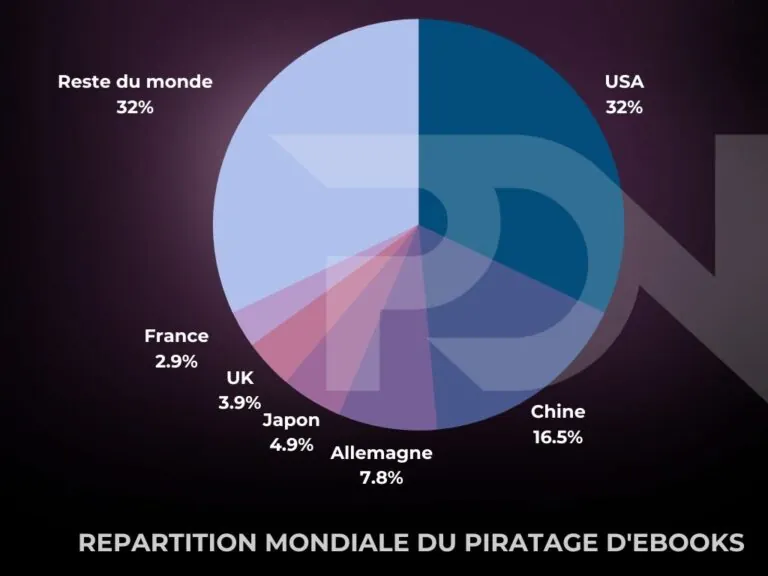
Ebook Piracy Around the World
In the United States, $300 million in publisher revenue is lost every year to online piracy, according to Authors Guild data presented at Book Expo 2019. But the United States is far from the only country affected.
Italy, for example, has studied the phenomenon in depth through reports carried out by IPSOS in 2019 and 2021.
AgencePDN gets this kind of content removed: see our Books and publishing service.
During the COVID-19 pandemic, book piracy cost the Italian publishing industry €771 million and about 5,400 jobs. In 2021, a new report indicated that Italians committed an average of 322,000 acts of book piracy per day, a major challenge for publishing. “In 2021,” the report's data tell us, “35% of the population committed at least one act of piracy involving commercial fiction and non-fiction books alone.
Other nations around the world also record notable losses: the Egyptian Publishers Union found in 2020 that piracy cost publishers $16.8 million a year, while the United Kingdom's Intellectual Property Office found in 2017 that 17% of all ebooks consumed that year, or 4 million units in total, were pirated.
Students in the Crosshairs
As the cost of education rises and students rely ever more heavily on tablets and laptops, more and more ebooks are available for download, legally or not. Some academic titles are even updated more often in electronic format than in print, and various enhancements to books, appendices, statistics and tables are often available only in electronic format.
Textbooks are often astronomically expensive, and students' resources do not always cover a full year's bibliography. The COVID-19 pandemic also closed university libraries, followed by very restricted access.
It is therefore very tempting to save several hundred or even thousands of euros per academic year through piracy.
Science, engineering, economics and law are the most affected – these are the fields in which academic books are the most expensive.
The American organization EducationData looked into the question, and over nearly 10 years the situation has worsened for students.
- A student spends on average 20% of their student loan on books
- A student spends on average between $700 and $1,500 a year on books
- A print book can cost up to $400
- Each new edition raises the price of the book by 12% on average
- Between 1977 and 2015, the cost of textbooks rose by 1,041%.
- The rise in textbook costs outpaced monetary inflation by 238% between 1977 and 2015.
- 37% of postsecondary instructors do not know the cost of the course materials when they select them for their classes.
Moreover, as books go out of print, professors who want to keep working with them sometimes allow or even encourage students to illegally download copies of the books in question; some students have even reported that professors explained which sites to find them on, or even sent them the illegal links or files directly for use in their courses.
According to the findings of the Italian survey cited above
- 81% of university students have committed acts of piracy
- 82% of respondents said they are aware that book piracy is illegal
- 64% of pirates believe they will be neither detected nor punished
- 39% said they did not consider it a “serious or very serious” offence
- In Italian universities, the number of unsold books is estimated at 6 million copies a year
- 35% of the Italian population aged 15 and over have downloaded or received a book downloaded from an illegal source
Consequences for Authors
Since 2009, when ebooks and ebook piracy became popular, authors' incomes have fallen by 42%, according to a 2018 Authors Guild income survey, with the median income from writing now so low – barely $6,080 a year – that the poverty level among authors keeps rising. In addition, a 2017 Nielsen survey found that people who admitted to having read a pirated book in the previous six months tend to be middle-class, educated men and women between 30 and 44 years old, with an average income of $60,000 to $90,000 a year. Strangely, some seem to genuinely like and respect the authors they pirate; some seem to think that putting authors' work online without paying them is somehow a form of praise. Book series are particularly vulnerable to piracy.
In our next article we will learn more about ebook piracy, and try to see whether there are viable solutions to reduce it.
In the meantime, if your product is being pirated, don't hesitate to call on our services; we work every day with publishing professionals (fiction, non-fiction, scientific and academic publishing) and have more than ten years of experience in this field.