Anime, Manga and Piracy

As we saw in our first article on anime, the anime market has many players, and producing these films and series is a process almost as costly as in traditional film.
Piracy therefore severely hurts the return on investment and the job market, and in turn holds back creativity. Indeed, if the revenue generated falls below forecasts, the production of new films and episodes will be compromised, and producers will be tempted to invest in more “commercial” formats and themes, hesitating to take artistic risks, in order to be sure the revenue generated will be sufficient.
Since the anime market is closely tied to the manga market, in this article we will also discuss piracy and the market for Japanese comics.
AgencePDN gets this kind of content removed: see our Film and TV service.
As with many other media, the pandemic of COVID-19 and the lockdowns caused a very sharp increase in piracy since 2020.
An explosion in the number of manga sold
At the same time, manga has never been so popular in Japan – sales records were in fact broken in 2020 and 2021, and the trend appears to be continuing in the first quarter of 2022.
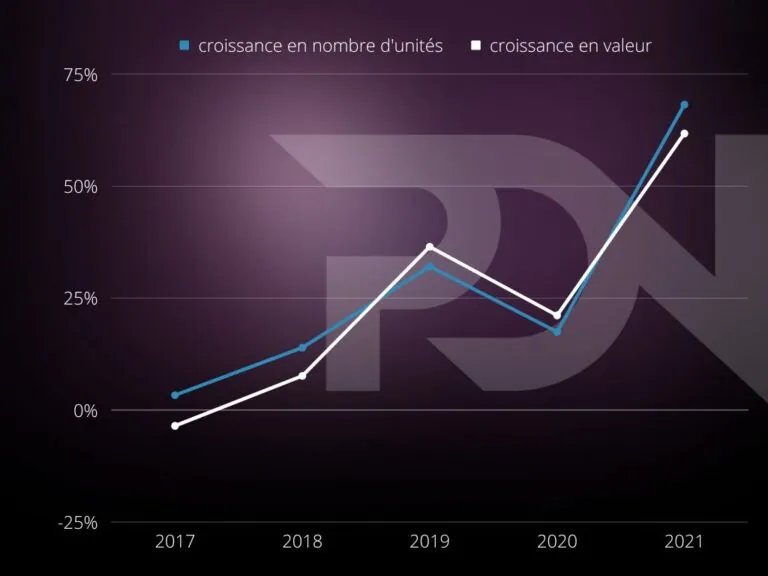
Manga market in Japan 2017-2021. Data from https://www.npd.com/
Manga and anime: the piracy numbers
Authorized Books of Japan (ABJ), a countermeasures group created by manga publishers, has compiled a list of 400 pirate manga sites. Because of the pandemic, the number of monthly visits to the top 3 pirate manga sites was multiplied by 26, reaching 326 million visits a month, compared with 12.5 million visits a month the year before. The estimated lost revenue based on visits to the top 10 pirate sites exceeded 780 billion yen (US$6.77 billion), a sharp increase from the previous year. Last year, the lost revenue was estimated at 210 billion yen (US$1.80 billion).
Since the two markets are closely linked by their themes and by the frequent adaptation of manga into anime, we can infer that a similar trend is emerging in anime piracy. Official figures rarely separate animated films and series from their live-action equivalents, so it is difficult to obtain exact data on anime piracy.
However, the big pirate sites such as Kissanime or 9anime record more visitors than official sites such as Crunchyroll or Funimation, the subreddits on anime piracy are very active, and the trend does not seem about to reverse. Despite the shutdown of Kissanime in March 2022, many mirror sites exist, hosting exactly the same content; these sites continue to be heavily visited.
A service problem
To quote Gabe Newell, president of the video game company Valve, the maker of games such as Dota and Counter-Strike, “Piracy is almost always a service problem and not a pricing problem.”
The full interview is available here, and Mr. Newell’s remarks, although they date from 2011, remain relevant and apply perfectly to this market: “One thing that we have learned is that piracy is not a pricing issue. It’s a service issue. The easiest way to stop piracy is not by putting anti-piracy technology to work. It’s by giving those people a service that’s better than what they’re receiving from the pirates.”
Many users in fact lament that a large amount of anime is not available in their country through official channels; these internet users then turn to piracy not because they are unwilling to pay, but because they simply cannot buy the product legally.
International groups – a long-term solution?
The Japanese anti-piracy group Content Overseas Distribution Association (CODA) launched, in 2022, a titanic project to fight the illegal online distribution of anime and manga. The international organization should eventually be made up of local companies such as the Japanese giants Shueisha, Kodansha or Toei, several Hollywood studios such as Disney, Universal or Paramount, Netflix, and about 450 Chinese companies, also members of the China Copyright Association. The group should initially bring together players from about fifteen countries.
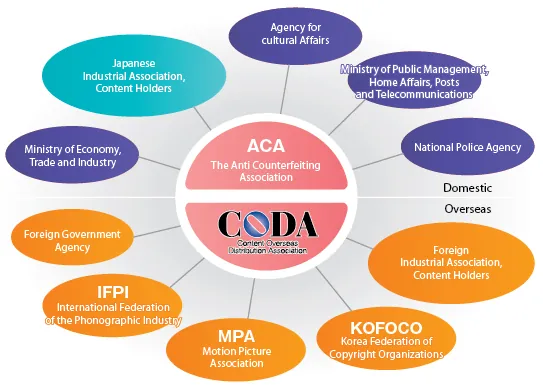
The CODA group – organization chart – summer 2022
Objectives:
- Exchange of information on anime and manga piracy around the world
- Cooperation with national and international authorities
This makes it possible, for example, to target the countries where servers are located. It is often international servers, out of reach of local authorities, that cause the most financial damage. For example, in 2021, Shueisha, a CODA member, asked the U.S. justice system for help in tracking down the operator of Mangabank, one of the largest manga pirate sites in the world, which was taken offline thanks to U.S. intervention.
Immediate solutions, accessible to all rights holders
Beyond the creation of international coalitions, there are more localized solutions available to rights holders. Even if they are imperfect, they can greatly reduce the impact of piracy on your revenue.
Blocking and shutting down sites forces pirates to constantly recreate mirror sites, and therefore to spend more to keep their illegal links available and their users informed; this makes them less competitive. In addition, some users get discouraged by a block or an address change, or simply no longer have access to information on how to find the new site.
Likewise, removing pirate links, even if they are likely to be put back quickly, forces pirates to invest more time and money to re-upload the links to the sites, and to create and maintain new, up-to-date sites.
If you need a company that specializes in protecting anime or manga, do not hesitate to contact us and speak with one of our account managers. We have more than ten years of experience in the field, and we will be happy to help.
Join us on August 15 for our new article on ebook piracy.