Why We Love Anime

What is anime?
Outside Japan, the word is used to describe cartoons or animated films produced in Japan, such as Naruto, Sailor Moon or the films of Studio Ghibli. The word is actually the Japanese word for “cartoon”. In Japan, people make no distinction by country of origin, and so use this term for any cartoon, whether it was produced in Japan or by Disney. The Japanese / non-Japanese distinction is therefore strictly Western. For this article, we will use this Western terminology, which therefore refers only to Japanese animation.
Anime is one of the forms of entertainment whose popularity has kept growing over the last few decades. Anime can now be found everywhere – on television, in movie theatres, on the major streaming sites, on social media, or even reworked as fan fiction.
An emblematic graphic style
Anime characters have a very recognizable graphic style: exaggerated character design, huge eyes, tousled hair, long, slender limbs. All these details allow the characters to express their emotions very visibly. Close-ups, zooms, slow motion, spectacular freeze frames, intense and contrasting lighting and very vivid colours are also elements that help create these very strong emotions in the characters, which are passed on to the viewer.
AgencePDN gets this kind of content removed: see our Film and TV service.
But beyond this visual aspect, it is also the very rich and complex psychology of the characters and the carefully crafted plots that have won anime a place in the hearts of fans.
Some anime are entirely original, others are adapted from or inspired by the world of manga or video games. All of this helps create a very rich culture and feeds a passionate community.
A short history of anime
Anime has existed in Japan for more than a century. These films reached the Western world through the United States, in the 1960s, with Speed Racer, which was a huge hit with children. For a long time, however, Westerners associated them with a pastime reserved for the very young.
Then, in the 1990s, Studio Ghibli had a series of worldwide successes, showing Westerners that anime could bring all generations together around the poetic productions, aimed more at adults, of director Hayao Miyazaki. The director is famous for the complexity of his tales for adults and children, the beauty of his line work, but also for the richness of the music that accompanies these exceptional films.
At the same time, during the 1990s and 2000s, a whole generation of children grew up watching Pokemon and DragonBall Z, broadcast on television in much of the Western world. Now in their twenties or thirties, they have often kept their taste for anime, turning to more “adult” titles.
Children's pastime or genuine art for adults?
In the United States and Europe, animated series were originally often marketed and designed for children; however, over the last twenty years or so things have been changing. In Japan, anime has always been aimed at people of all ages. Anime can be categorized into dozens or even hundreds of genres and subgenres, aimed at a very wide range of audiences.
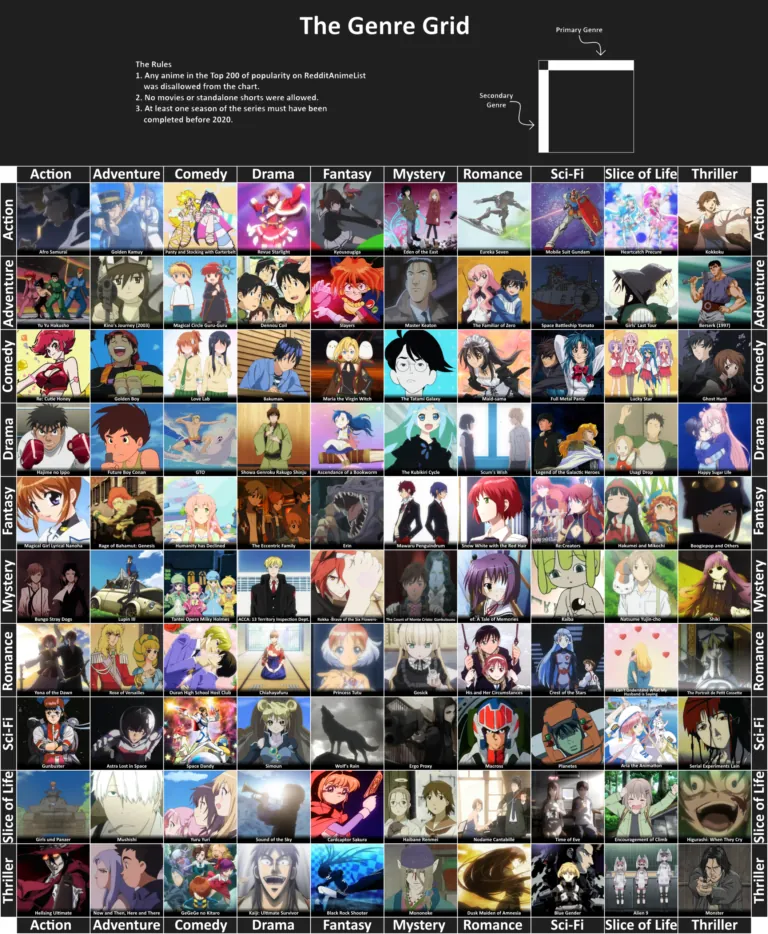
This user of the r/anime thread on Reddit created a reading grid of 100 anime, which helps convey some of the richness of the genre.
The players in the industry
The complexity of the content created is reflected in the cost of the process: it takes about between 100,000 and 300,000 USD to produce a single episode. This is explained in particular by the number of players in the production process. The business model is fairly close to that of film or television series, with a few specific features.
Producers
Production companies are a sort of interface that allows the players to communicate with one another. They are the ones who pay the studios' initial costs for production, the television networks' for broadcasting, and the distributors' for bringing the work to market. Companies like Aniplex have begun vertical integration by creating their own animation studios and distribution subsidiaries.
Distributors
Distributors acquire the rights to distribute and market the work created, for a defined period, in a specified territory. The major anime streaming services such as Crunchyroll, Funimation and Netflix are now full-fledged distributors, and many production companies make deals directly with them, with no other intermediary.
Television networks
Japanese television networks are an essential link in the anime value chain. Not only do they serve as distribution channels, but many of them also take part in production committees, which makes it possible to find sponsors and advertisers to help finance their creations. In Japan, the national television market segment is about twice as large as the national streaming market, which may seem surprising – in the rest of the world, it is streaming that largely dominates. This gap will likely close in the coming years, possibly reversing the trend.
Animation studios
Without the work of the animation studios, anime simply could not exist. The studios are behind the design and creation of the content. To do this, they need to hire a large amount of staff.
- A director who oversees the whole operation,
- Character designers
- Episode directors in charge of the storyboard and direction of the episode
- Teams specialized in layout
- Animation specialists themselves
- A compositing team that imports all the images into a computer, colours them, and adds computer-generated images and special effects
- A team specialized in post-production
- Actors who lend their voices and their emotions to bring the characters to life
Manga publishers
Using source material that is already popular, such as a manga, is one of the recipes for a series' success; manga publishers are therefore naturally part of the creative process for many anime. However, unlike the Western comics market, where publishers hold at least some of the rights, in Japan it is often the mangaka who keeps their copyright, for commercial, legal and cultural reasons specific to Japan.
The importance of the market
This is a fast-growing market that generates significant revenue. In the United States, for example, with revenue of $22.8 billion in 2021, and growth of more than 7% a year, it could reach $48.8 billion in 2030.
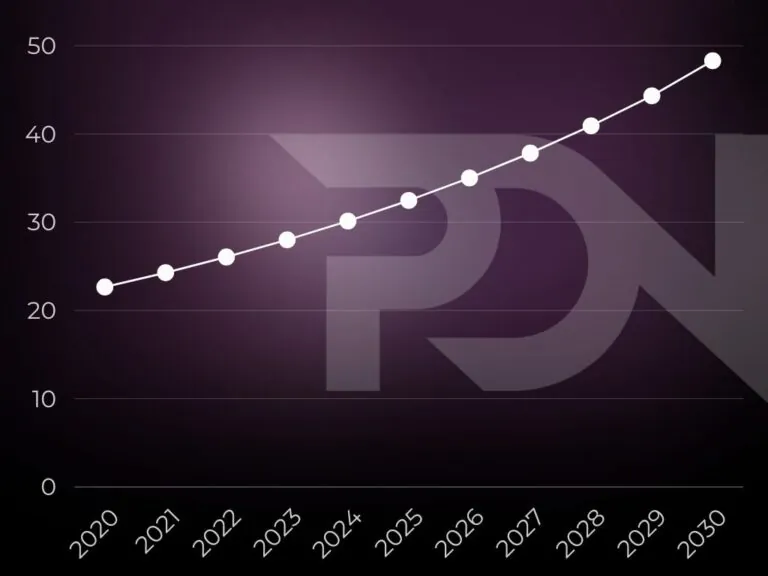
Projected evolution of the anime market, assuming the 2021 and first-half 2022 revenue figures and growth of 7.2% a year – the growth recorded between 2020 and 2021
(source: precedence research).
All of these players are deeply affected when anime is pirated; the size and diversity of the sector mean that many jobs are threatened when these players are not paid as they should be, because their works are stolen to be broadcast illegally. Moreover, given the market's strong growth, these negative effects can only grow if nothing is done to fight piracy.
Join us in early August to find out what the consequences of piracy are in anime, and how to fight this scourge. Don't hesitate to contact us if you have an animated series or film to protect; we are Canadian leaders in this market, and have more than a decade of experience in protecting anime.