Hollywood's Fight Against Piracy: A War Without End? (2)

We saw in the first part of our article that technology and public education were not necessarily very effective at curbing piracy. After a slight dip in the mid-2010s when Netflix became popular, piracy figures remain stable or even rise. Solutions therefore exist, but they remain imperfect.
Collaborative Strategies
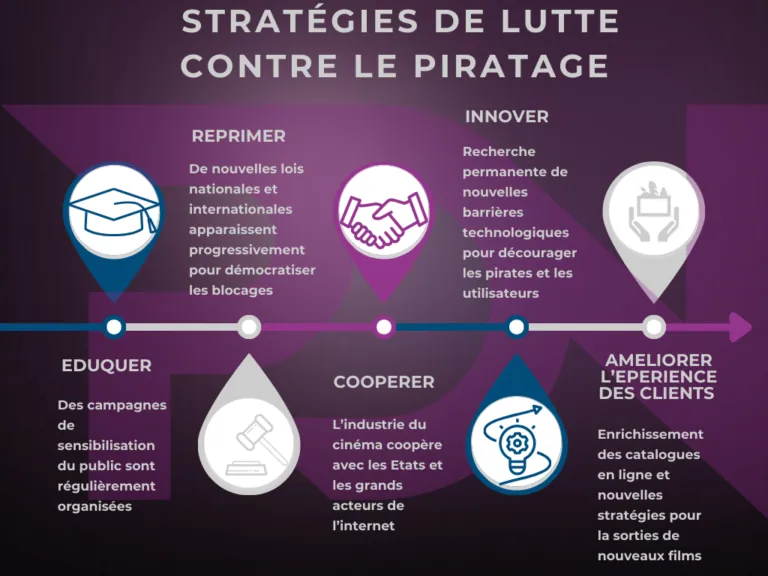
Piracy is a global problem and requires a coordinated response between countries. International treaties, such as the Anti-Counterfeiting Trade Agreement (ACTA), and cooperation efforts with bodies such as Europol have sought to harmonize laws and enforcement actions against piracy on a global scale, but this international framework is still taking shape and remains very imperfect.
In addition, Hollywood works with technology companies and internet service providers to identify and block pirated content. Detection algorithms and takedown notification systems are key tools in this battle. Platforms such as YouTube use sophisticated systems to detect and remove copyrighted content. For example, YouTube developed the Content ID system, which allows copyright holders to find and manage their content on the platform, but here too the system has its limits, and most takedowns require action from the rights holders.
AgencePDN gets this kind of content removed: see our Film and TV service.
Legal Enforcement and Its Limits
One of Hollywood's main strategies in fighting piracy has been legal enforcement. There have been many lawsuits against pirate sites and the individuals responsible for the illegal distribution of content. Notable examples are the lawsuits against The Pirate Bay and Megaupload, two of the largest illegal file-sharing sites.
However, these legal actions have their limits. Shutting down a pirate site does not necessarily stop users from finding other sources of illegal content. Moreover, the owners of these sites are often located in jurisdictions where it is difficult to prosecute them effectively. As a result, despite high-profile convictions and site closures, piracy continues to thrive.
The Motion Picture Association is also trying to push for more binding legal mechanisms. In 2011, the U.S. Congress had already tried to impose access restrictions on sites identified as sharing pirated content, but the Stop Online Piracy Act bill was rejected. In April 2024, the MPA announced that it wanted to put pressure on Congress once again to bring a restrictive bill back to the forefront, notably seeking to expand and ease the issuing of court-ordered blocking orders.

New Business Models
To counter piracy, Hollywood has explored new business models. Subscription streaming platforms, such as Netflix and Disney+, offer legal access to a vast library of content for a fixed monthly cost. These services have managed to attract millions of subscribers, but the multiplication of platforms and the cost of stacking subscriptions make piracy attractive.
In addition, studios are experimenting with simultaneous theatrical and streaming releases. This approach lets consumers choose how and where they want to watch films, shortening the delay between theatrical release and digital availability, a period often exploited by pirates. However, this is not possible in every country, since national laws sometimes prohibit such a practice.
The Impact of the COVID-19 Pandemic Is Still Being Felt
The COVID-19 pandemic had a major impact on the film industry and on the fight against piracy. With cinemas closed and many film releases delayed, consumers turned to streaming platforms for their entertainment. This shift intensified the pressure on Hollywood to secure its content online and offer attractive legal alternatives.
Studios accelerated the release of films on streaming platforms and adopted hybrid release models, in which films are available both in theatres and online on the same day. This strategy aims to counter piracy by offering immediate, high-quality availability to consumers, reducing the need to look for illegal copies.
Toward an Uncertain Future
The fight against digital piracy is far from over. Every day, new piracy technologies and methods emerge, forcing Hollywood to innovate and adapt constantly. For now, after-the-fact methods, namely regularly searching for pirated versions and quickly removing the offending links, remain the best solution for protecting your intellectual property.
A specialized company with trained staff and suitable tools can help you effectively. If you have a film, a series, software or an ebook to protect, don't hesitate to call on our services by contacting one of our account managers; PDN has been a pioneer in cybersecurity and anti-piracy for more than ten years, and we certainly have a solution to help you. Happy reading, and see you in July for a new article!
Share this article