The Resurgence of Piracy (2)

Piracy: $113 Billion in Losses by 2027?
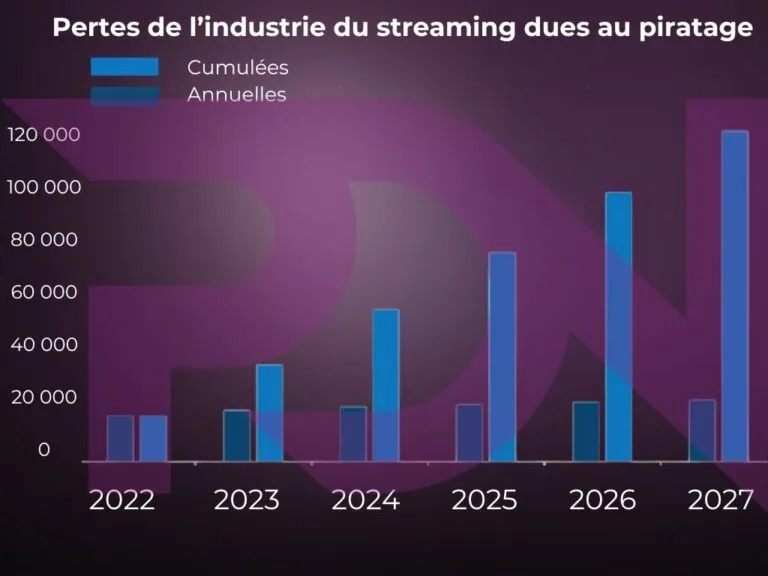
According to a report by Parks Associates, video streaming providers in the United States could lose $113 billion by 2027 because of content piracy.
According to the report, piracy of films and series is expected to rise from less than 22% currently to more than 25% in 2027, which clearly shows a reversal of the downward trend observed over the previous decade. Pirates will likely focus on password piracy on streaming sites. Europe and the Asia-Pacific region record more piracy per capita, but piracy is highest overall in the United States and India.
India is notably one of the countries most affected by piracy. It combines the influence of Anglo-Saxon culture, a very popular domestic film production (Bollywood films) and a low income per capita. Coupled with the country's population and the strong growth of its young population, India represents a major challenge for content creators, producers and distributors.
AgencePDN gets pirated content removed: see our solutions by sector.
After an increase explained by the COVID-19 pandemic and a decline once things returned to normal, a new rise in piracy has indeed been observed: in 2023, visits to online pirate sites reached 141 billion, an average of 386 million visits per day, an increase of 12% over the previous year.
Resurgence of Piracy in Europe
These worrying forecasts are not limited to the United States. A 2023 study by the EUIPO, the European Union's intellectual property agency, shows that after several years of decline, online piracy is rising again. The efforts of recent years therefore seem to be reversing, at a time when streaming sites see their growth slowed by a combination of rising subscription prices, a growing number of possible subscriptions and a significant increase in desirable content, to which is added the debate over data storage.
TV shows and series are the most pirated content (48% of all content in Europe), but piracy of live events is also rising sharply. The trend observed in recent years continues: illegal streaming sites are the most popular (58% of piracy), while downloading now accounts for an increasingly residual share.
Differences between countries are also very pronounced: piracy is very widespread in Estonia and Latvia, whereas in Poland, a country that is nevertheless a geographic and cultural neighbour, piracy accounts for only 5% of all content viewed. In Greece, for example, 25% of the content consumed was obtained illegally, while in Italy the rates are low. It therefore seems difficult to find a geographic logic to this distribution.
Countries also differ in terms of the volume and type of content consumed. Piracy is most popular in Estonia and Latvia, while it is relatively unpopular in Germany and Italy. There are also different preferences for the type of content. In Greece, film piracy accounts for 25% of the total volume of piracy, for example, while in Poland it is only 5%.
The Return of Music Piracy?
Music piracy had decreased enormously for several years. Thanks notably to a coherent offering from paid services such as Spotify, which provide access to a very large catalogue at a reasonable price, the music industry seemed to have more or less put piracy behind it. And yet last year, in 2023, music piracy rose instead of falling for the first time in nearly 10 years. The increase is admittedly modest, at 13%, but it seems nonetheless that the development of software for downloading content from YouTube, in particular, is a trend that is being confirmed in piracy.

What Solutions?
At present, there seems to be no other solution than a detailed understanding, by companies involved in the creation, production and distribution of copyrighted content, of the reasons and patterns of piracy, and an adaptation of the business models offered to these changes.
Technical and legal barriers are in fact proving rather ineffective for the time being; as a result, for now, only solutions aimed at removing content found on illicit sites, together with careful monitoring of how these pirate sites evolve, seem to be a viable way to curb the resulting loss of revenue.
A specialized company with trained staff and suitable tools can help you effectively against the piracy of your content, and will help you regain control of your revenue. If you have a film, a series, software or an ebook to protect, don't hesitate to call on our services by contacting one of our account managers; PDN has been a pioneer in cybersecurity and anti-piracy for more than ten years, and we certainly have a solution to help you. We would be delighted to put our expertise at your service. Happy reading, and see you in August for a new summer theme!
Share this article