Piracy as a Service and Illegal Revenue

The fragmentation of the legal offer
Following the fragmentation of streaming services and the resulting acceleration of the content war, further heightened by the Covid-19 pandemic, piracy, after a decline and a period of stability, has picked up again at a very sustained pace.
One recognized problem is that legal platforms now share the most popular content between them, whereas a few years ago a Netflix subscription was enough to satisfy the vast majority of viewers. In 2022, in most Western countries, you would have to spend $70 to $80 a month to get all the streaming services, allowing you to watch both the latest releases and the classics you like to rewatch. This amount does not include sports streaming and its specialized broadcasters; add sports and the bill would nearly double.
This is why even users who were not originally pirates now tend to download films and series available on services they are not subscribed to, so that legal and pirate practices coexist.
AgencePDN gets pirated content removed: see our solutions by sector.
In Australia, for example, the group Creative Content Australia, funded by the audiovisual industry, carried out a study that notably determined the typical profile of a pirate, which may be surprising. Amy Pettinger, the group's chief executive, said that when they profiled the people who pirate, the majority of them are university educated, earn more than $90,000 a year and subscribe to more than three subscription services. They are prolific consumers of content, which brings us back to the fact that they feel they have a kind of right to pirate because they already pay for services. This model of the educated, well-off pirate who already subscribes to several services is found in other Western countries and in other studies on piracy, for example in illegal ebook downloading in the United States.
In recent years, to meet these growing needs, pirates' activity has become structured, almost industrialized. Pirates now offer services to other pirates, providing them with part of the infrastructure needed to launch this illegal but increasingly lucrative activity.
Before looking at this new phenomenon in detail in our next article, let's look at the structure of piracy revenue.

The evolution of the piracy business model
The piracy business model has made considerable progress since its beginnings. Poor-quality recordings made at a preview screening are now a thing of the past; illegal content is available immediately in high quality, and stolen directly from the source.
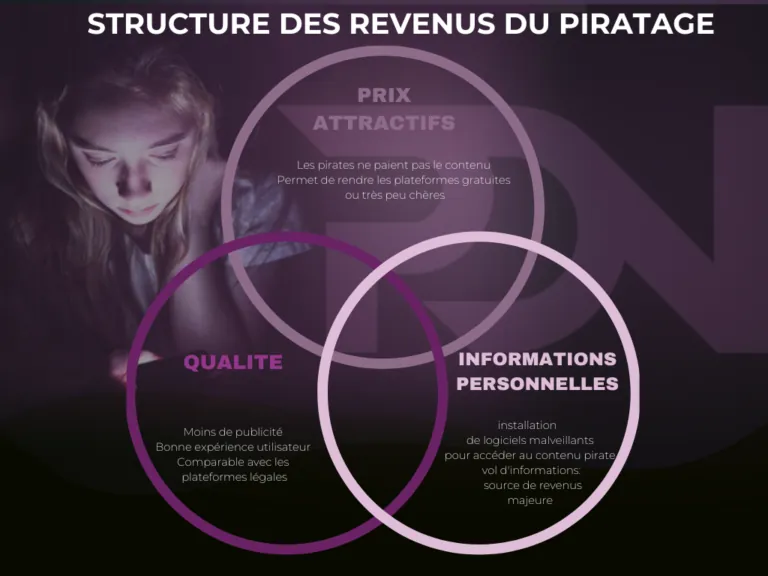
Pirates' profits come from the following activities:
- Selling pirated films or setting up an illegal streaming platform
Since they have no licence fees to pay and far lower investments than Netflix or Amazon, which buy and create their own content, pirates can easily offer very attractive prices, on video on demand or on an illegal streaming platform.
- Theft of personal information
Pirated content is offered apparently for free. Often, however, the user has to install special software to access it. This software then gives access to customers' devices and to their personal identification information. This information is then sold on the dark web. In extreme cases, the victim's device will even be used in DDoS attacks.
Some combine both business models, charging a subscription while illegally collecting their customers' data.
- Less advertising
Some pirates have adopted the business model of asking users to watch online ads to access the pirated content. One of the main differences between legal video-on-demand services and pirate services is the amount of advertising. Because illegal services do not pay to acquire or produce their content, they can afford far less advertising, which is much more appealing to viewers tired of the amount of advertising on legal platforms.
Some illegal services offer such ease of navigation, content discovery or account management that the quality of the user experience is judged to be much better than that of legal services. Some customers even mistake these new services for a legal service.
In our next article, on October 15, we will try to determine how the creation of so many services on such a scale became possible, notably through services offered by pirates to other pirates.
In the meantime, if you need a specialized company to protect your content, don't hesitate to contact us and speak with one of our account managers. We have more than ten years of experience in the industry, and we will be happy to help you put effective solutions in place to protect your content.
See you soon!