Piracy as a Service and Content Protection

In our last article, we saw that the structural changes in the world of piracy were significant enough to justify its industrialization. One of the means enabling such a development of an activity – a very lucrative one – was notably brought to light by the representative of the Hollywood studios, the Motion Picture Association (MPA), in its report.
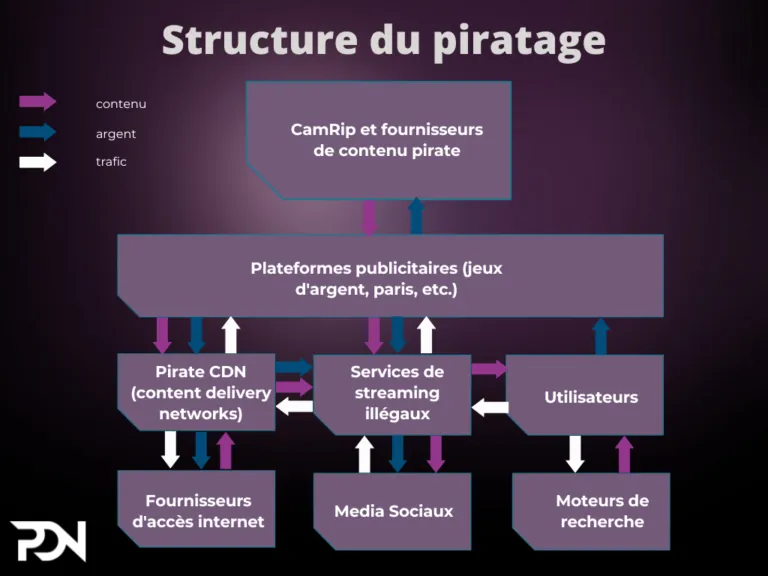
For the first time, the report mentions, alongside well-known players such as torrent sites, streaming portals and IPTV services, a brand-new category, which the association calls piracy as a service (PaaS, Piracy-as-a-Service).
This growing category of piracy refers to the tools and services that allow would-be infringers to easily set up a piracy campaign, offering a set of ready-to-use services. These turnkey packages help them both to build their service and to monetize it. There are bundles that include IPTV platforms, video service providers, content management systems, in short, everything a pirate looking to get into the business might need to quickly set up a working service. According to the MPA, these services illustrate the scale, sophistication and profitability of modern commercial online copyright infringement.
AgencePDN gets pirated content removed: see our solutions by sector.
The problems with piracy as a service
In its report, the MPA cites several of these “offerings,” such as the XFileSharing scripts, the domain name registrar Njalla, the IPTV Smarters management suite and the video integration service Fembed.com. A number of domain names are also cited as being very tolerant of those who infringe copyright, for example .is, .to, .io or .tv, well known to pirates. The MPA points out that it is possible directly or through its contractual relationship with its registrars to remove or disable domain names used by websites engaged in massive copyright infringement.” Even though, in principle, a court decision is needed to disable a site, according to the MPA, this process should be made easier in cases of massive and manifest copyright infringement.
The MPA also points to the sometimes “problematic” role played by advertisers, advertising agencies and hosting companies such as AdsKeeper, Propeller Ads, 1XBET, BlueAngelHost and Ddos-Guard.
Even publicly traded companies such as Mail.ru, VK.com and Baidu are flagged as problematic, accused of not filtering content enough and of not reacting quickly enough when a copyright violation is reported to them. the MPA notes that Baidu should apply rigorous filtering technology to identify illegal content, in order to take more effective measures to suspend or terminate repeat infringements. Likewise, the messaging service Telegram is accused of not having sufficiently effective takedown tools.
Protecting content: a multilayer strategy
In such a context, how can you protect content from these malicious players without compromising the user experience?
Several aspects need to be addressed in parallel.
- When content is not in use, care must be taken to properly encrypt video files while they are stored and prepared for streaming to the user's device, in order to prevent an internal leak.
- Digital rights management (DRM) solutions must also be put in place, which are supposed to ensure that content is streamed only to a recognized device and by an approved user. These solutions also protect video content as it travels over public networks. In a typical DRM system, for example, video content is sent encrypted and cannot be used without a content key.
- Once the video content has been delivered to the device, it must be decrypted so it can be processed and displayed to the user. This is the stage at which the video can be intercepted by malicious software, either by a user who knowingly pirates the video, or by a user who installed the software unwittingly.
- This is therefore the stage at which the streaming service assesses the security level of the device being used to determine whether it is eligible to receive the content. If the device does not meet the security level, the content will not be delivered. If the device is assessed as safe, the content will be sent. However, at the time of transfer, other protection techniques must be used to detect any tampering with this transmission. Indeed, it is by detecting such tampering that piracy is detected.
- Finally, traceability makes it possible to uniquely identify the content used by each device. If the content is pirated, it is possible to determine which device was the source of the leak. This is particularly useful during live events, where quick action to stop the stream to a leaking device can disrupt pirates' ability to deliver their service and monetize the pirated content.

The inadequacy of proactive methods
However, we must not forget that all of these methods are heavy and costly, that they slightly degrade the user experience, and that they are by no means foolproof.
They must therefore be combined with careful searching and rapid takedown; despite all these precautions, it is indeed very likely that your content will end up on pirate sites anyway.
If you need to protect your content, don't hesitate to contact one of our account managers. Our ten years of experience in the anti-piracy field make PDN the ideal partner to make sure your intellectual property generates the profits that are rightfully yours.
Join us in November, in our next article, when we will look at the role of Cloudflare and its influence on piracy. Happy reading, and see you soon!