Anti-Piracy: Action or Prevention?

For an effective fight against the piracy of your films, series, video games and ebooks, there are two paths: prevention, or what we can call active methods.
Let’s take a look at these two ways of limiting piracy and assess their respective effectiveness.
Preventive methods: a mixed record
“Technical” methods are widely used in the video game industry, and are in principle designed to prevent the console or PC from launching the game if it does not come from an original source.
These methods also exist for ebooks (often in the form of DRM) and for films and series – in that field, watermarking is no doubt the most widely used.
The idea that technical locks can be placed at the entrance to prevent piracy has existed for a very long time, since as early as 1985 Nintendo created a system for its first consoles — the NES — that in principle only allowed cartridges bearing the company’s logo to be read.
AgencePDN gets pirated content removed: see our solutions by sector.

Over the years, the video game industry has seen activation keys, game alterations, DRM, watermarks, and the “always online” requirement launched by Diablo 3 and popularized by Steam — which has since become the norm in a very large number of games.
It now seems that the most promising method for the coming years is blockchain technology. Indeed, apart from its other well-known applications in cryptocurrency, blockchain allows very reliable authentication, which could let a person be tied to one specific copy of a game, thereby preventing piracy.
And yet, these methods are heavily criticized, and for very good reasons.
Whatever technique is used, pirates have always found a way around it — many even see them as a challenge and enjoy bypassing them as quickly as possible.
In addition, many DRM-type methods have been accused of slowing games down and causing technical difficulties and performance drops even for players with legal versions, as numerous articles on the anti-piracy and anti-cheat software Denuvo show.
Preventive methods, while they do not eliminate piracy at the source, often make it possible to trace illegal activity, which makes later takedown actions easier.
These methods can also help limit the contamination of networks by infected files. For this, watermarking seems particularly effective.
Active methods: betting on simplicity
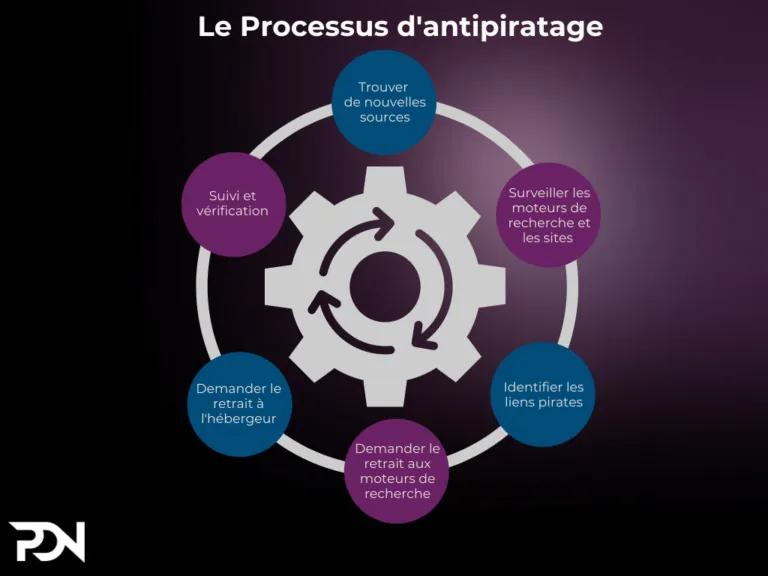
First, you have to detect the existence of the pirate file on the networks. This means sweeping all the search engines using relevant keywords, and separating fake pirate links (scams) from real copies of your product.
A Google search is not enough to find all the links, either — many pirates have now turned to Russian search engines, which are less censored.
This search must then be supplemented by a sweep of dedicated sites and discussion forums — not all of them will show up in a general search.
Of course, each file must be checked individually — many companies, pejoratively called “DMCA farms,” send thousands of requests a day without any verification, thereby removing perfectly legal files as well as promotional tools, making your product less visible and causing you to lose revenue.
Takedown notices
You then have to request removal from Google so that search results pointing to pirate sites containing an illegal version of your product are removed.
But this step only erases the search results (and only on Google) – you still have to contact the host of each file. You therefore have to identify the responsible host. Indeed, the pirate site itself will never remove your content, even if some claim to. You therefore have to find out who to send the takedown notice to so that it is effective, and follow up as needed. You will then have to carry out rigorous tracking to know which files have been removed and which are still to be handled. And once you have done all that… you will have to start over.
If this sounds long and tedious, it is because without cybersecurity experience, and without the right tools — combined with human verification — it truly is!
Even so, if you carry out all these actions over several weeks or months (depending on the scale of the problem), removing the search links and the content at the source, directly with the host, remains the most effective method.
Conclusion
Of course, one of the most effective “tools” remains, above all, offering a good product, at the right price, that is widely available
The reality is that no method gets rid of 100% of piracy. Unfortunately, at present, it is still very easy to find illegal copies of the latest video games, the latest films and series, or popular ebooks, even after search engines have been cleaned up.
Does the task seem too long, too technical?
Call on our team of experts. At PDN we have more than 10 years of experience in the field and cutting-edge cybersecurity tools that optimize searches. Thanks to our double verification, with a human involved at every step, we make sure that none of your legal links is removed by mistake, and our takedown rate is close to 97%.
In our next article, join us for a piece on the film industry, and discover the very impressive figures on the effects of piracy on this industry.