5 Questions About the DMCA
1. What is the DMCA?
The Digital Millennium Copyright Act is a U.S. law passed in 1998 to fight piracy on the internet by criminalizing the unauthorized use of copyrighted content.
Thanks to the DMCA, any author can have unauthorized content that infringes their rights removed.
Although it is an American law, the DMCA actually concerns everyone — YouTube’s servers, for example, are located in the United States, and all the content posted there must comply with that country’s law, and therefore with the DMCA.
Most hosting providers, even in countries that do not directly apply the DMCA, have now gotten into the habit of removing content that infringes the DMCA, and the list of countries that do not apply it is shrinking drastically (fewer than ten countries in the world in 2021).
2. Why is it so controversial?
- The penalties are often considered disproportionate, personal use is prohibited, and even attempted piracy is punished.
- It is accused of not respecting the free flow of information, of being the enemy of an “open” Web — in short, of being a brake on freedom of expression.
- It is an outdated law — it is more than 20 years old — that is no longer necessarily suited to today’s Web, and in particular to questions such as: who owns a meme? Should the DMCA be applied on social networks, and if so, how? Streamers, in particular, have often been very critical of this law, since they were used to playing music during their gaming sessions — music whose rights they had not acquired.
- Its application sometimes leads to absurd situations. At BlizzCon 2020 — which could only be held online because of the health situation, the band Metallica gave a surprise concert. But in the live broadcast on Twitch, the band’s music is not what you hear at all – Twitch having considered that its broadcast infringed the DMCA. Yet it was indeed an official performance by the band, authorized by all of their rights holders… Since then, the videos of this strange performance have been removed from the Web, but the situation perfectly illustrates the contradictions this law is blamed for.
3. The DMCA: a tool for creators?
These criticisms pale in the face of a very simple observation: nobody wants their work stolen so that others can gain an audience and revenue from it. Nobody has the right to use your content without permission – whether it is music, video, photos, text or software. People who explicitly favour free sharing of the content they have created have many tools at their disposal: open source in general, copyleft licences such as Creative Commons…
AgencePDN gets pirated content removed: see our solutions by sector.
Online as in life, consent is essential.
Practices are evolving, and streamers are now increasingly careful to use only royalty-free content, which also allows artists who publish free music to be showcased in a way they may never have imagined. Twitch has also published on its platform a very detailed FAQ on DMCA compliance, providing content creators with a set of tools to help them in this process.
4. How can I protect my rights with the DMCA?
By filling out a simple DMCA form.
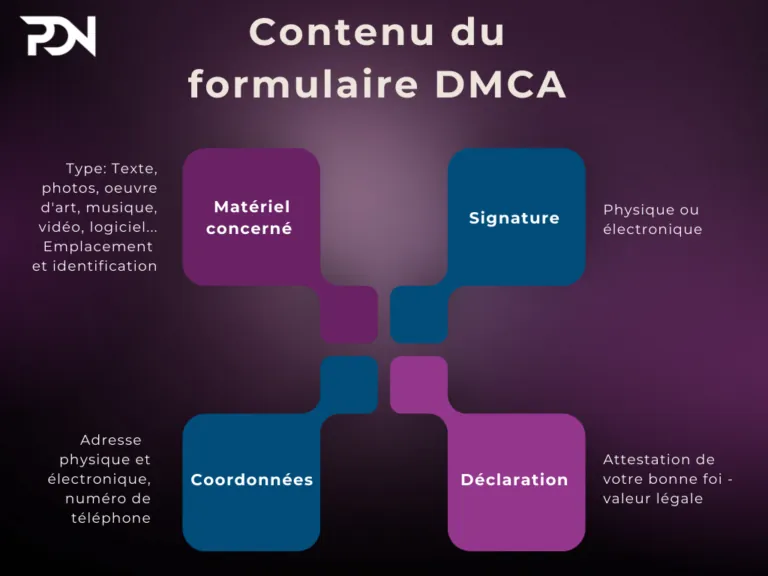
Your content does not need to be registered, but you will very likely be asked for proof that you are indeed its owner, or that you are acting on behalf of a rights holder. You must include a certain amount of information for the request to be considered:
- A physical or electronic signature.
- The location and identification of the material that infringes your copyright.
- Your personal contact information (address, phone number, etc.).
- A statement attesting to your good faith and the accuracy of all the information — under penalty of perjury.
You can also request the removal of search engine links that point to content infringing your copyright.
5. Is it complicated?
The request itself remains relatively simple.
Nevertheless, keep in mind that you will be disclosing personal information (address, phone number) and that you will be legally staking your word — if you make a false statement, you also risk being sued. In addition, you can only file a DMCA notice if you have specifically identified content that belongs to you — which requires systematic and often time-consuming research.
That is why, if you want to make your life easier, do not hesitate to call on a company that specializes in this field. Our team at PDN will be happy to help and guide you through the process, so do not hesitate to contact us!
Join us for our next article: how to put an end to the piracy of your products and which methods are most effective – preventive methods, or active methods?