Piracy and Cinema: Colossal Losses

The film market is dominated by a limited number of major studios, around which a multitude of very small companies orbit. Likewise, it is the biggest titles that share a major portion of the profits from VOD, DVD and Blu-ray sales and box office receipts, while the number of small productions is almost infinite.
The market is thus divided between these big-budget mainstream productions concentrated in the hands of a few players, and independent cinema.
The most common piracy practices are:
AgencePDN gets this kind of content removed: see our Film and TV service.
- Streaming on illegal platforms
- Torrents
- Direct download (DDL)
- Credential sharing on legal platforms
The report titled Impacts of digital video piracy on the US economy, produced on the initiative of the US Chamber of Commerce, estimates that 80% of film piracy takes place on illegal streaming platforms.
A constantly growing loss of revenue
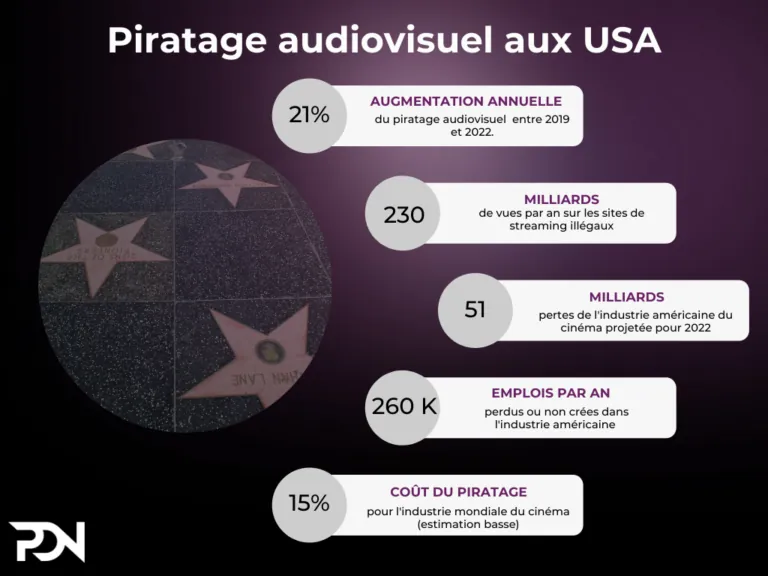
As with any illegal activity, exact figures are hard to find. There is, however, data for certain countries, which makes it possible to extrapolate the results to the rest of the world. In 2019, videos on illegal streaming services accounted for more than 230 billion views a year, of which 15 billion came from the USA. 30% were films, and 70% were episodes of series. (source: Statista)
Online piracy is estimated to cost the American economy between $29 billion and $70 billion a year (between 10 and 24% of the film industry's revenue). These figures were published in 2019 in the report commissioned by the US Chamber of Commerce, and projections show that in 2022 this loss will be at least $51 billion, which represents an increase of 21% a year based on the $29 billion of 2019.
For the television industry, this loss is estimated at $39 billion to $95 billion.
A loss of revenue automatically leads to a loss of jobs. The damage caused by piracy is estimated at at least 260,000 jobs, in the United States alone.
In France, according to the consulting firm EY, the French film industry was already losing nearly 1.4 billion euros in 2016. This figure was steadily rising compared with the two previous years, so it seems logical to assume that the trend continues. EY also states that this estimate is conservative, and that the real loss to the industry is probably much higher. Even so, this low estimate already represents about 15% of the sector's revenue, which is consistent with the study published by the US Chamber of Commerce.
By cross-checking these studies, we can therefore estimate that piracy represents at least 15% of the film industry's revenue.
One internet user in three also consumed films and series obtained illegally in France in 2016. Since this figure is based on self-reporting, it is reasonable to think that it is actually much higher. As internet users' skill at finding illegal content is constantly increasing, this figure has probably increased further in 2022.
An Ipsos report carried out on behalf of the Australian Federation Against Copyright Theft (AFACT) also revealed that 45% of people who pirate films would have gladly paid to watch a legal version if they had not had access to the pirated version.
Making pirated content harder to access by removing illegal content online therefore does seem effective in getting some internet users to start paying for content again. It is thus the main tool to help you increase your revenue.
Explosion of credential sharing in 2021
Once again the data is mainly available for the USA but can be extrapolated to the rest of the world.
About 80% of adults use legal streaming services (Netflix, Amazon Prime, etc.), which represents about 214 million users in the United States.
88 million of these users reportedly borrow the credentials of friends or family members to log in to these legal streaming services.
This shortfall would represent $4 billion a year in 2021. In 2020 the loss was estimated at $2.6 billion.

Despite some difficulty finding figures, we have identified a few trends:
- The figures published in all the reports are very conservative so as not to overstate the problem. The real impact of piracy on the film industry is therefore probably even higher.
- These figures are increasing steadily every year. If we add the impact of the restrictions related to the covid-19 epidemic on piracy, we can only think that this trend will become more pronounced in the coming years.
- Large companies are the hardest hit, because the most pirated films are mostly blockbusters. However, their greater means allow these companies to survive despite the loss.
- Independent film producers, by contrast, can suffer far more from a loss of revenue. For this business model, piracy is particularly harmful and greatly damages the diversity of the sector's output. Any loss of revenue is that much money that will not be reinvested in a future production.
It is therefore essential to find solutions to limit piracy, and to safeguard the revenue and jobs of this key cultural sector.
For this, a company specializing in the protection of audiovisual content can make an enormous difference. The savings made may perhaps allow you to finance that film you didn't think you could afford to make.
Don't hesitate to contact us, one of our experts will help you define a tailor-made solution, perfectly suited to your needs and your means, whatever the size of your business.
Join us for our next article, still about the film industry, and take back control of your revenue by learning how to protect your products.