Twitch and Piracy (2)

We saw in our previous article that, thanks to the platform’s policy and efforts, music was not really a piracy problem on Twitch. However, the live streaming of pirated matches (football, boxing, hockey, basketball) is booming on Twitch, despite the tools put in place.
For example, in January 2019 alone, sports fans accessed sports pirate sites 362.7 million times, according to data collected on Statista. A few years ago, these sites were mainly independent sites (and their army of clones), but the model has now changed: links are exchanged on Discord, and a large number of them now lead to an ephemeral Twitch channel, created specifically for the sporting event of the moment. And these channels have copies: as soon as one stream is removed, another appears immediately.
One of the appeals of Twitch is that the mainstream platform now has such wide recognition that it is a safe reference, especially since Reddit shut down the very popular subreddit r/soccerstreams, which helped Internet users find links to pirated soccer matches.
AgencePDN gets this kind of content removed: see our Fraudulent ads service.
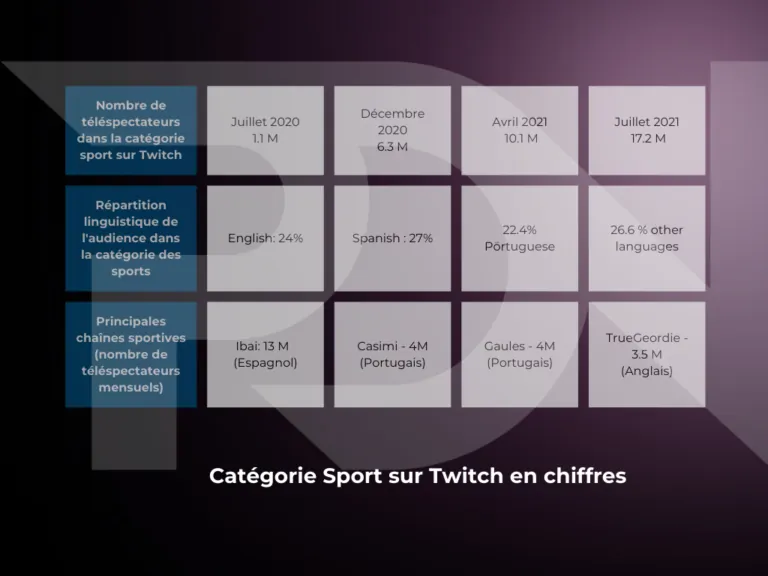
As early as 2019, the final of the football World Cup was watched on Twitch by more than 90,000 people even though the match was not officially broadcast there. Indeed, in recent years the platform has diversified; a bastion of video games, it now hosts all kinds of content, and sports hold a prominent place. Three channels gathered most of those 90,000 viewers.
The rise of the online sports events market
The market for broadcasting sporting events exceeds $20 billion in the United States; it is therefore natural that rights holders want to protect their investments as best they can. But sports piracy has become so commonplace that even sports journalists are not immune to this scourge. Soccer journalist Luis Paez-Pumar, a subscriber to NBC Fox, ESPN and Bein Sports, told Wired magazine that every time he can’t find a match on one of the big channels he subscribes to, he goes to Twitch.
He admits that he watches an average of one soccer match a week on Twitch. He knows it’s not ideal, but sometimes there is no other option, apart from taking out an overpriced premium subscription.
We have already talked several times about the problem of fragmentation of the offering. Sports broadcasting offerings suffer from it just as much; this phenomenon and the growing popularity of Twitch make the platform the new favourite destination of pirates.
Lawsuit against Twitch: a symptom of how significant piracy is
Some federations have tried asking Twitch to put a stop to these practices; other companies have tried the legal route, as in Russia. Indeed, Rambler, Russia’s third-largest internet company, filed a lawsuit against Twitch in December 2019 over the broadcast of an English Premier League stream. The company claimed $2.8 billion in damages, alleging that Twitch had contributed to 36,000 violations of its rights over football matches. Rambler Group dropped the suit a few days later, but such a legal action is symptomatic: it shows how seriously sports piracy on Twitch has come to be taken by rights holders.
For its part, Twitch says it is doing everything it can to counter the phenomenon and stated that the platform “will continue to, as has always been the case, effectively and swiftly address any violation of its terms of service with the removal of unlicensed copyrighted content.”
But like other distributors, the platform defends itself by claiming that it merely provides access to users, without publishing content itself, and cannot modify published content or detect possible intellectual property violations other than music. Twitch nonetheless says it does everything to eliminate the violations reported to it.
It is very difficult to put a precise figure on the lost revenue resulting from these pirated broadcasts. We only know that it is very substantial, in a market that is growing more and more.
If you want to take back control of your revenue from sports streaming, in addition to offering an attractive offering to fight fragmentation, it is essential to call on a specialized company. Indeed, while removing links on the internet can be done (with a lot of effort) on your own, live monitoring of a sporting event cannot be improvised. Specialized tools and trained staff are indispensable.
Our process, developed over the years, allows illegal broadcasts of live events to be removed very quickly. In this field, time is of the essence, and we guarantee near-instant removal. Don’t hesitate to contact one of our account managers so that we can present our solutions to you!
Join us in mid-June for our next theme: piracy of applications and software.