Twitch and Piracy, Part 1: Music
While piracy through YouTube is a relatively well-known phenomenon, another streaming platform is now increasingly in the spotlight when it comes to piracy: Twitch.
Twitch is a streaming platform known for its video game content, but that definition does not cover all of its activity. The platform, now owned by Amazon, has grown extremely fast in recent years.
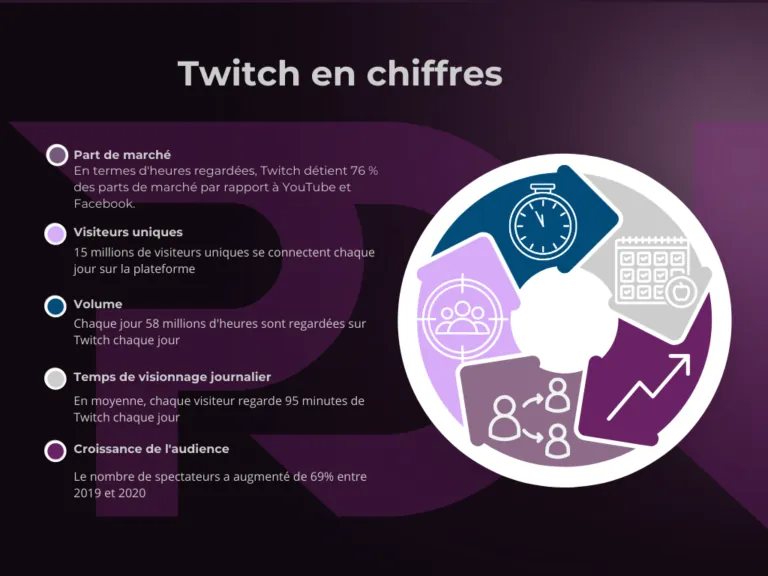
For 2022, Twitch’s revenue is estimated at $2.8 billion
AgencePDN gets this kind of content removed: see our Fraudulent ads service.
In 2016, revenue was $275 million
Nearly 8 million people stream on Twitch at least once a month
41% of the platform’s users are under 24, a demographic group that is among the most likely to consume illegal content, or not to object to the broadcast of clearly illegal content; it is also this age group that considers copyright on the internet an outdated model
There is more and more non-gaming content on Twitch: music channels, political discussions, sports, cooking… these sectors are growing strongly on the platform.
How does piracy show up on Twitch?
The most frequent scenarios are the following:
- A streamer plays an illegally downloaded video game
- Protected music is played without authorization during a stream
- Live sporting events are rebroadcast on a channel
Since it is hard to really know whether the game being streamed by the streamer was acquired illegally (even though some say so openly), we will look at the situation of music on Twitch in our first article, before turning to the case of sports broadcasting.
The measures taken by Twitch
Twitch presents itself as a platform that defends creators; its policy is therefore, of course, to ensure that copyright is respected. But in practice, how does this intent show up?
The platform has tools for broadcasters that remind them of the rules, and in particular of the ban on broadcasting any content that does not belong to the creator and for which they have not acquired the rights. During their gaming or cooking sessions, streamers often play music.
The platform therefore provides them with lists of royalty-free content that they can play freely.
In case of copyright violations, the platform reacts in three stages: two warnings are sent to the broadcaster who failed to respect copyright; the sound of their video available for replay may also be muted with a message saying they did not comply with the DMCA, or the entire video may be removed from the channel.
At the third warning, the broadcaster will be banned for a time, which has in fact happened to Gotaga, one of the most famous French-language streamers on the platform.
To find out whether illegal content has been broadcast, or more precisely music only, Twitch has a tool: Audible in principle detects the musical content of the stream and warns the streamer that they have played music that is not royalty-free.
In practice, it is in fact very rare for streamers to buy music rights in order to play such music during their sessions; it is therefore up to them to prove that they may have paid for the right to broadcast a protected artist’s music; by default, Twitch considers that the DMCA has been infringed.
The other way to spot illegal music is of course to watch the stream and make a report to Twitch. However, the multiplicity of channels seems to make the task almost impossible.
Should music piracy on Twitch be fought?
In reality, the platform, unlike others, is relatively effective on this particular point; indeed, the Audible tool seems to perform rather well, and over time more and more streamers are turning to royalty-free content, now that they have taken on board the rules that have been put in place.
Many, however, would like to see a global royalty put in place, which would pay artists while promoting their music.
Join us in early June for the rest of our article; indeed, while the situation of music seems not very problematic on the platform, a growing phenomenon, with far greater financial stakes, seems to be taking on worrying proportions: the illegal broadcasting of sporting events online on Twitch. This will therefore be the subject of the second part of our study.
In the meantime, don’t hesitate to contact us if you need help protecting your content; we are here to inform and help you!