Spotting and Fighting Deepfakes
The first step in fighting deepfakes is knowing how to spot them. There is currently no 100% reliable technical way to detect a fake, since most images are retouched in any case, even though there is AI-based software that can expose the crudest ones. The first step is always to exercise your critical thinking. You need to ask whether the information is credible, and whether anyone would have an interest in publishing the photo or video in question. If the information “revealed” by the deepfake is not reported by trustworthy news sources, and what the person says or does in a video is shocking or important, the media will talk about it. If no trustworthy source mentions it, that can mean it is a deepfake.
There are also a number of purely physical elements you can look for when trying to tell whether an image or video is fake.
How to Spot a Deepfake
The simplest things to look at are signs of naturalness in very specific parts of the body.
AgencePDN gets this kind of content removed: see our Fraudulent ads service.
- Eye movement: especially in videos, eyes that don’t blink are very telling; algorithms learn a lot from photos, and in the photos found online, people don’t often have their eyes closed. Also, eye movements generally follow the person being spoken to, so they are hard to reproduce realistically.
- Facial expressions: they can look unnatural and express no emotion at all
- Body movements: if they are jerky, or if some parts don’t move in sync with others, that can give away a fake video. Makers of crude deepfakes focus mostly on the face, so body movements or positions are quite often unnatural enough to make the fake fairly easy to spot.
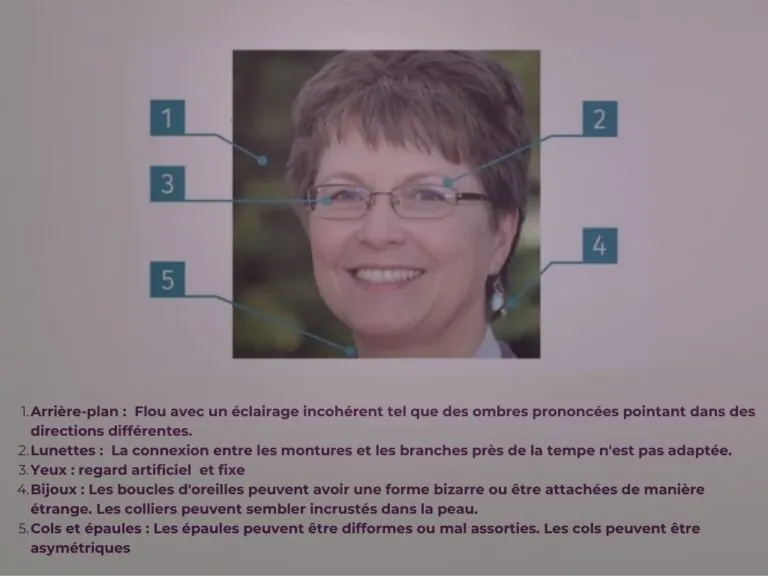
- Shadows: the way light falls on the face can fairly easily reveal a fake image or video, because shadows will fall in a way that is inconsistent with the setting and positions
- Hair that is too perfect: generally in deepfakes, the generated faces are perfectly groomed; the algorithm doesn’t necessarily pick up on stray hairs and therefore doesn’t learn them
- Teeth that lack naturalness: algorithms don’t seem able for now to generate slightly imperfect teeth, because that would require working tooth by tooth; deepfakes therefore have a “dentures effect”
- Sounds that are not consistent: deepfake creators generally pay more attention to either the image or the sound
- A video played in slow motion can sometimes reveal a lack of synchronization between speech and lip movements
- An image on a big screen: deepfakes are often made for people watching on their phones. On a larger screen, such as a computer monitor, the details can show up more easily.
It is also possible to use reverse image search to find similar images online; for the moment there is no publicly available tool for reverse video search.
Other Avenues for Fighting Deepfakes
In 2019, Facebook launched the Deepfake Detection Challenge, which aimed to bring together tech companies, as well as universities, to encourage them to develop detection tools ahead of the 2020 election. But the project never really took off and seems to have been at a standstill since, notably after Facebook refused to remove videos even though they had been detected as deepfakes.
The other avenues for preventing the spread of deepfakes are, as always, international cooperation among governments on legislation, and public awareness, notably through education programs for young people.
In terms of cybersecurity, companies should apply a “zero trust” method and systematically verify all information, and train and encourage employees to do the same, by providing them with tools and reference people to help them verify whether information is true.
Join us in May for our articles on little-known facts about piracy. In the meantime, if you have a film, a series, software or an ebook to protect, don’t hesitate to call on our services by contacting one of our account managers; PDN has been a pioneer in cybersecurity and anti-piracy for more than ten years, and we are bound to have a solution to help you. Happy reading, and see you soon!
Share this article