What Are Deepfakes?

At the start of 2024, social media was flooded with fake pornographic images of Taylor Swift. One of them was viewed nearly 50 million times on Twitter/X. It is not the first time such a scandal has happened, but the immense popularity of the singer, named Time magazine’s Person of the Year for 2023, forced politicians to speak out and call for legislation on the subject. Deepfakes are, indeed, currently under-regulated. What are they, and what problems do they pose?
What is a deepfake?
The word “deepfake” comes from “deep learning” and “fake.” Deepfakes are synthetic media that have been digitally manipulated to convincingly replace the likeness (photo, video) of one person with that of another. They can also be computer-generated images of human subjects who do not exist in real life.
Deepfakes were born in 2017 when a Reddit user posted doctored pornographic clips on the site. In these videos, the faces of celebrities and those of porn actors had been swapped.
AgencePDN gets this kind of content removed: see our Fraudulent ads service.
Today, many deepfakes are pornographic.
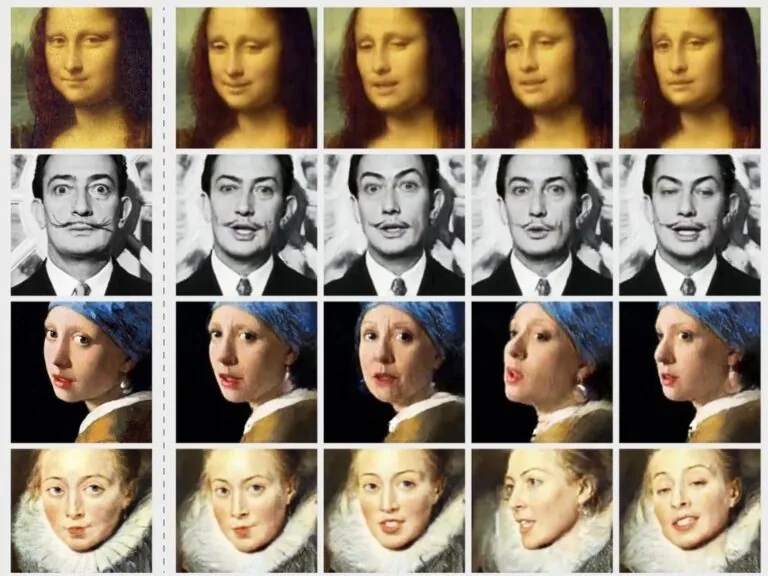
Example of deepfakes made from famous works of art.
How are they made?
First, thousands of photos of the faces of the two people have to be run through an artificial intelligence encoding algorithm. The encoder finds and learns the similarities between the two faces and reduces them to their common features, while compressing the images. A second AI algorithm, the set-top box, then learns to recover the faces from the compressed images. Two set-top boxes are used: one recovers person A’s face, the other person B’s. The compressed images of person A are then fed into the set-top box trained to recognize person B’s face; the set-top box then reconstructs person B’s face, using the expressions and attitudes of face 1.
For a convincing video, this operation has to be performed on every frame. But new techniques now allow unskilled people to make deepfakes with just a few photos. There are now free tools available online that let anyone simulate these steps very easily, such as the site https://deepfakesweb.com/.
The dangers of deepfakes: revenge porn and corporate security
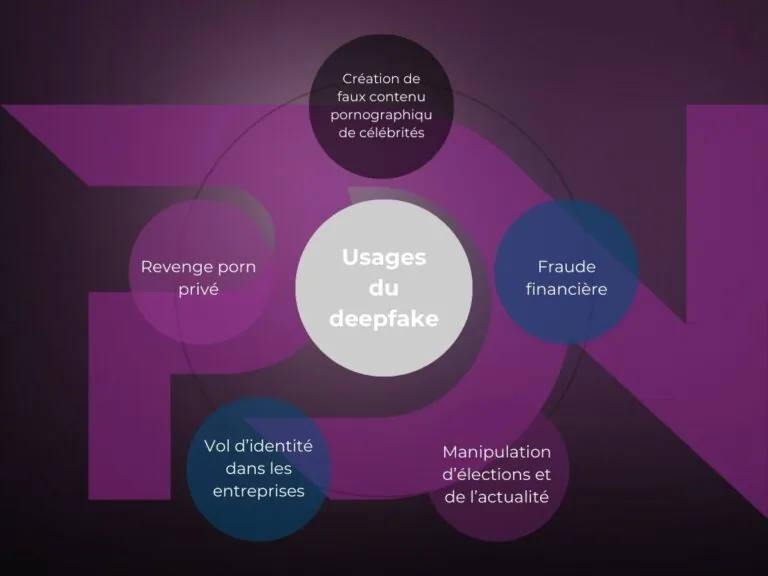
Manipulation, disinformation, defamation or humiliation: the people discredited (overwhelmingly female stars) are on the front line. Private revenge porn, now that the technology has become far more accessible, is also one of the most frequent uses of this technology.
In a study carried out in September 2019, the artificial intelligence company Deeptrace found 15,000 deepfake videos (twice as many as nine months earlier). More than 96% of this content was pornographic, and 99% of it mapped the faces of female celebrities onto porn stars. Insufficient moderation on many social networks, and particularly on Twitter/X, has been pointed out many times. Politics is also a prime target: fake images compromising prominent figures are generated, and fake phone calls from Joe Biden were recently made to discourage voters from taking part in the upcoming presidential election. False information about ongoing armed conflicts is also created this way. Entire disinformation campaigns can thus be created in a few clicks, by almost anyone, even with limited technical skills and at low cost.
But this technique now also creates major security problems for businesses: recently, several employees of large companies were tricked by phone calls reproducing the voices of executives, and even by a fake Zoom video conference, and made transfers of tens of millions of dollars on the fictitious orders of superiors authorized to request such operations. A VMware report revealed a 13% increase in deepfake attacks last year, with 66% of cybersecurity professionals saying they had witnessed one in the past year. Many of these attacks are carried out by email (78%), which is linked to the rise in Business Email Compromise (BEC) attacks. This is a method attackers use to gain access to a company’s email and impersonate the account owner in order to infiltrate the company, the user or partners. According to the FBI, BEC attacks cost businesses $43.3 billion in just five years, from 2016 to 2021. Platforms such as third-party meetings (31%) and business collaboration software (27%) are increasingly used for BEC, with the IT industry the main target of deepfake attacks (47%), followed by finance (22%) and telecommunications (13%). It is therefore essential for companies to stay vigilant and put in place deepfake detection technology and robust security measures to protect themselves and their organization against this type of attack.
Deepfake identity theft has therefore become a worrying problem for corporate security. Moreover, as the technology evolves rapidly, these fake images, voices and videos are becoming harder and harder to identify. The problem has now largely moved beyond the private sphere and can no longer be ignored, by governments or by businesses.
In our next article, we will look at what solutions can be adopted to fight this phenomenon. In the meantime, if you have a film, a series, software or an ebook to protect, don’t hesitate to call on our services by contacting one of our account managers; PDN has been a pioneer in cybersecurity and anti-piracy for more than ten years, and we certainly have a solution to help you. Happy reading, and see you soon!
Share this article