Software Piracy: A Growing Challenge (1)

Software piracy means infringing the intellectual property of legally protected software. It includes copying, distributing, modifying or selling such software. In general, it is an intentional practice: pirates copy a program and redistribute it through peer-to-peer networks or direct download sites. There is also unintentional or unwitting piracy: all it takes to be guilty of piracy is to buy a licence for a product and install it on several devices within the same entity (household, small business).
Worrying figures
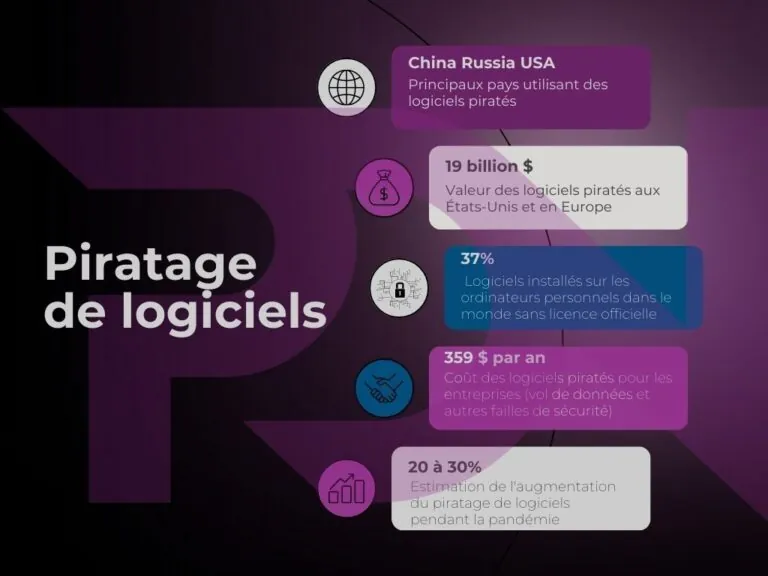
Software piracy has become a major problem in recent years. China, the United States and India are the three main offenders, according to a global study carried out in 2019.
According to that study, the commercial value of pirated software comes to $19 billion in North America and Western Europe and $27.3 billion in the rest of the world. The same survey found that 37% of the software installed on personal computers was unlicensed. It is very likely that the Covid-19 pandemic (lockdowns, and many career changes, including business start-ups) only made the phenomenon worse. Experts estimate that software piracy rose by 20 to 30% during the pandemic, and has remained stable since.
AgencePDN gets this kind of content removed: see our Software and games service.
Beyond those who do it out of ideology, convinced that software should be free and accessible to everyone, most people pirate because some software, especially professional software, is particularly expensive. Many consumers of pirated software are students or small entrepreneurs who need professional software to start their business but cannot afford a licence costing several thousand dollars. Moreover, software piracy does not necessarily require advanced computer skills; almost anyone with a computer can become a small-scale pirate if they choose to.
A review of piracy methods
As more and more software is developed and brought to market, pirates are constantly looking for ways to get around security measures and to distribute illegal copies, free or paid, of the latest software, but also of “classic” software such as Photoshop (one of the most pirated programs in the world).
Pirates use various well-known methods:
- modifying the source code to bypass licence protections
- using illegal licence key generators
- distributing modified versions of software containing malware or viruses
Other types of piracy are tied to the behaviour of the end user:
Softlifting
A person buys one copy of a program and installs it on several computers, even though the software licence is for a single user. This type of piracy often occurs in small and medium-sized businesses, families and schools, and is generally meant to save money; the price of the software is the deciding factor here. It is the most “innocent” and most common type of piracy.
Overuse
Several people use a main copy of the program at the same time, although only one licence was purchased and installed on a server. This often happens in businesses. It is a version of softlifting, with a single official licence used many times.
Hard-disk loading
Someone buys a legal copy of the software and reproduces it to resell it. This practice often occurs in used PC resale shops when the device is sold with software already installed. The buyer generally does not know that the software supplied with the PC is illegal.
Counterfeiting
Software is illegally duplicated and sold, as physical copies or over the internet, usually at a lower price than the official software.
Online piracy
Online piracy is the best-known and most common form of piracy: software is shared (for free or for resale) exclusively on sites devoted to sharing pirated content (films, series, music, software) through peer-to-peer or direct download. These sites are generally very easy to find and open to everyone. These are also the sites where users are most likely to run into malware.
Join us in early July for the rest of our article. In the meantime, if you have content to protect – software, of course, but also a film, a series, a music album or a sporting event – don't hesitate to contact one of our account managers. We will be happy to help, so that you can take back control of your revenue!