Software Piracy: What Solutions? (2)
As in every sector, software piracy has a very significant economic impact on publishers, who lose substantial revenue because of illegal copies distributed for free or sold at reduced prices on the black market. This of course directly affects their ability to invest in the research and development of new products, and has a negative impact on jobs.
As in other sectors, legal action against pirates is often difficult to bring; as with any piracy that uses the internet, the international nature of the offence greatly complicates matters. In some countries, the end user is punished, but this is not a truly effective solution to the problem.
The Negative Consequences of Software Piracy
Pirated software may be cheaper, but it carries many dangers for the end user
AgencePDN gets this kind of content removed: see our Software and games service.
- Increased risk of the software malfunctioning or failing
- No access to the program's after-sales service: training, updates and patches, support
- No warranty
- Inability to update the software
- Increased risk of the PC being infected by malware, viruses or adware.
- Slower computer performance
- Legal consequences for copyright infringement (even if, as we said above, these consequences are ultimately very limited)
The study cited in the first part of our article highlighted many risks linked to malware:
- A one-in-three chance of inadvertently downloading malware when businesses install unlicensed software.
- Each malware attack can cost a business an average of $2.4 million
- Such an attack can take up to 50 days to be fully resolved
- Can cost more than $10,000 per infected computer
- Costs businesses nearly $359 billion a year
- Negative impact on the company's brand and reputation
- Potential loss of business data
What Are the Methods for Preventing Piracy?
Software piracy is the result of products that are too expensive for some users, of insufficient quality, or of an absence of added value between a pirated product and a legally purchased one. It is therefore essential to offer impeccable service, an attractive image, regular updates and responsive customer service for absolute customer trust.
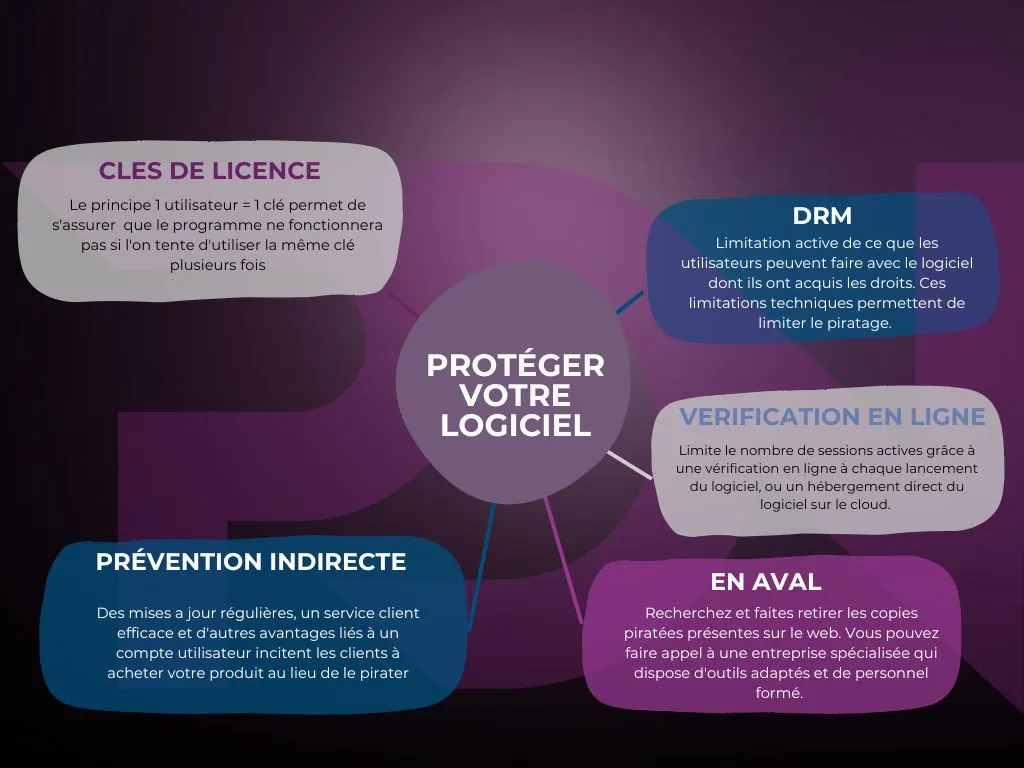
However, this is obviously not always enough. Two stages must be distinguished to achieve maximum protection of the product:
Upstream
- security measures that protect your software against copying, sharing or redistribution.
- Indirect prevention measures that give your target group additional incentives to buy your product instead of pirating it. If updates are regular and substantial, and the publisher listens to feedback from its community, users will indeed often prefer to buy the licensed product rather than pirate it.
Downstream: search and removal
Searching for and removing pirated copies helps make the pirated software hard to find. Calling on a specialized company to have illegal copies removed will clean up copies present on both direct download and torrent sites, and on search engines, multiplying the chances that your product will be hard to access in its pirated version.
“Classic” protection measures to counter piracy.
- Use license keys
Licences, or product keys, are a unique identifier that you give your user when they purchase the right to use your software.
Because the program can only work with the license key attached to it or with the user's account, it is impossible to copy or redistribute it.
However, there are key generators that can often get around this barrier; these generators are often available for the most popular programs.
- Use digital rights management (DRM)
The software you create belongs to you, and users pay for the right to use it. They therefore do not buy it the way they would buy a physical product.
Digital rights management (DRM) is a way to enforce this rule, but it is often disputed by end users. Nevertheless, DRM is perhaps copyright protection in its purest form. It can be applied to video games, video and audio files, emails, ebooks, films and so on. It actively limits how users are allowed to interact with the software or file.
For example, an email can be read, but it cannot be forwarded. A video game, even a non-multiplayer one, may require an online connection or verification through an online account.
Supporters of DRM say it is an ideal method of copyright protection, because it limits use of the software product exclusively to the registered end user. Critics, for their part, argue that this method on the contrary restricts the end user too much, even though they paid to acquire the rights.
- Require online verification to use software
This method has also been criticized.
It may involve online verification at each use, or the software itself may be accessed from the cloud. An online key tied to the user's account will then be a way to access the program, often on several devices, but limiting active sessions to one at a time.
In reality, as in many sectors, the only solution lies in a combination of several methods:
- searching for illegal copies online on piracy-focused sites
- greater awareness of the consequences of software piracy
- cooperation between businesses, governments and users.
Join us for our next article in mid-July, in which we will talk about artificial intelligence in the context of piracy and anti-piracy. In the meantime, if you have a product to protect, don't hesitate to contact us; one of our account managers will present all the solutions we have to help you regain control of your revenue.
Share this article