Artificial Intelligence: birth and development

In our summer series on artificial intelligence, we will try to paint a picture of the major issues surrounding artificial intelligence: what is AI? How have different sectors been transformed by its appearance? What are the benefits and dangers in the field of cybersecurity?
In recent decades, the public has mostly been introduced to the figure of artificial intelligence through fiction: the replicants of Blade Runner, the droids of Star Wars and HAL in 2001: A Space Odyssey left their mark, but few people imagined they could ever become reality. Thanks to progress in deep learning and natural language processing, AI is no longer a futuristic dream, but a contemporary reality. But how did we get here? That is what we will discover in this first part.
The Turing test
The goal of AI is to create algorithms or methods that allow computers to learn on their own from data, experiences and interactions with the world around them. This is how human intelligence works: we acquire knowledge and learn to understand by observing the world around us, through trial and error, by reflecting on our experiences. By interacting with the world, we constantly receive new information and use it to improve our understanding of the world.
AgencePDN gets pirated content removed: see our solutions by sector.
In the 1950s, the mathematician Alan Turing invented an artificial intelligence test meant to answer the question “can machines think?”: if a human converses with two entities, a human and a machine, and cannot determine which of the two is the human and which is the machine, the machine will have passed the test.
In the 2010s a number of machines came close to success, with no consensus on exactly how many, or even on whether the test was really passed. Most of the time, the AI Eugene Goostman, which persuaded 30 humans that it was a 13-year-old Ukrainian boy through text conversations of about 5 minutes, is considered the one that came closest in 2014.
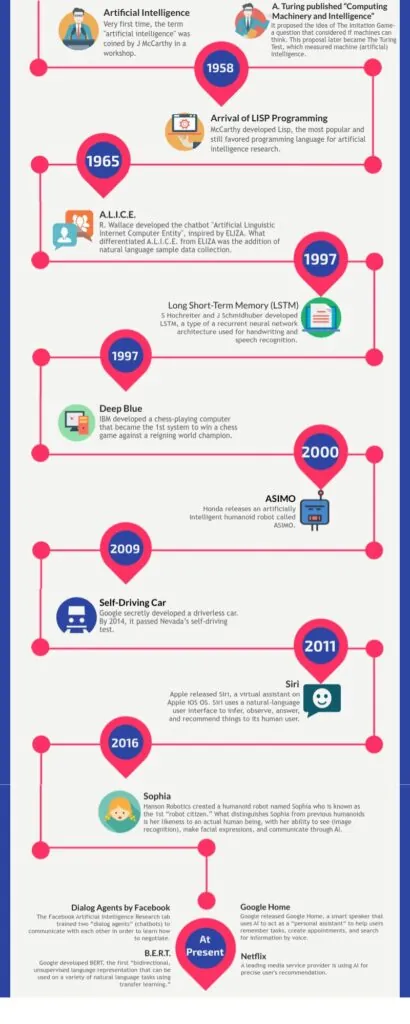
A brief history of AI
The term “artificial intelligence” was chosen by John McCarthy in 1956 at the Dartmouth conference, whose goal was to study intelligence in detail so that a machine could be built to simulate it.
In the 1960s and 1970s, AI research turned to developing expert systems designed to imitate the decisions made by human specialists in defined fields. These methods were frequently used in sectors such as engineering, finance and medicine.
In the 1980s, programs began to take an interest in machine learning, and were able to solve algebra problems stated in words rather than numbers; this is when AI first used language, which would eventually lead to the ChatGPT we know. This is how neural networks were created, modelled on the structure and workings of the human brain.
The 1990s were marked by a shift toward machine learning and data-driven approaches, thanks to the increased availability of digital data and advances in computing power. This period saw the rise of neural networks and the development of support vector machines, which allowed AI systems to learn from data, resulting in improved performance and adaptability. It was also at this time that natural language began to be simulated particularly realistically, notably by the programs STUDENT and ELIZA – the very first chatbot.
Things have accelerated particularly in the last 20 years. In the early 2000s, progress in speech recognition, image recognition and natural language processing was made possible by the advent of deep learning, a branch of machine learning that uses deep neural networks.
Finally, in the 2010s AI became a truly visible part of our daily lives: smartphones, virtual assistants, chatbots on many commercial sites, up to the GPT revolution.
How GPT changed the game
The recent explosion of AI is largely attributed to the development of deep learning techniques and the emergence of large-scale neural networks, such as OpenAI's Generative Pre-trained Transformer (GPT) series.
In 2015 OpenAI was co-founded by Elon Musk, Sam Altman, Greg Brockman, Ilya Sutskever, John Schulman and Wojciech Zaremba. The founders were aware of both the potential and the risk of AI and wanted to promote these technologies in a way that would preserve safety.
The association became a company in 2019 and in 2023 signed a partnership with Microsoft: “Today, we are announcing the third phase of our long-term partnership with OpenAI through a multiyear, multibillion dollar investment to accelerate AI breakthroughs to ensure these benefits are broadly shared with the world.” (Company statement on the occasion of this merger).
The evolution of GPT models
- 2018: GPT-1, 117 million parameters trained on a dataset of about 8 million web pages.
- 2019: GPT-2, a more powerful version of GPT-1 trained on a much larger dataset of about 40 GB of text and 1.5 billion parameters.
- 2020: GPT-3, trained on an even larger dataset of about 570 GB of text and 175 billion parameters.
- 2021: OpenAI releases Codex, a language model trained on code with 6 billion parameters and 800 million lines of code, which powers GitHub Copilot, an AI-powered code completion tool.
- In 2022, OpenAI releases ChatGPT, which you probably use. ChatGPT is an updated version of GPT-3, called GPT-3.5. OpenAI has not revealed the amount of data used to train ChatGPT.
- In March 2023, OpenAI announced the release of GPT-4, its most advanced language model to date. GPT-4 has improved reasoning capabilities and greater accuracy in solving complex problems. Access to the GPT-4 API is gradually being made available to developers on a waiting list. Its capabilities seem clearly superior to those of the current ChatGPT.
While for the moment it is still easy to spot weaknesses in today's AI, the exponential speed of its development leads us to believe that we are on the verge of an immense upheaval in technology, and thereby in the world, because of the changes these AIs bring to our daily lives and to a growing number of professions. This article was not written with the help of ChatGPT… but could it have been? Quite certainly, or almost, just like the code contained in this web page.

In the next part of our series, we will see how different industries are evolving because of the introduction of these AIs, and what the positive and negative repercussions may be for cybersecurity.
In the meantime, don't hesitate to contact us if you have content to protect, and come back and read us in August for the rest of our series on artificial intelligence.
Share this article