Effective methods to protect live events

With each new edition of the World Cup, the number of viewers using illegal IPTV grows. The latest edition was no different, and it is estimated that nearly 30% of viewers used illegal streams during the tournament.
A new type of discussion was also recorded on Reddit and Quora: it seems that viewers used to stick with one IPTV provider for the whole tournament. Now they look for information in discussion threads and switch services depending on the match.
This edition of the World Cup was also marked by the specific features of the Middle East region: even though piracy looks similar from one region to another, problems in the region are made worse by legal systems that do not necessarily address the issue, and a highly developed culture of piracy.
AgencePDN gets this kind of content removed: see our Live sports service.
It should also be added that some people, sensitive to the “sportswashing” from which Qatar benefited to hide the country's human rights problems, considered piracy a form of resistance and believe they have found a way to watch a sport they enjoy without funding the economy of a country whose politics they despise.
However, rights holders are not powerless against this phenomenon; the factors listed above have simply made them more proactive, and a range of methods have been put in place by broadcasters and by national and international authorities to fight it.
As a result, about a hundred sites and their mirrors were shut down from the United States, several countries including France, Morocco and Canada issued blocking orders ahead of the broadcasts, and arrests accompanied these actions.
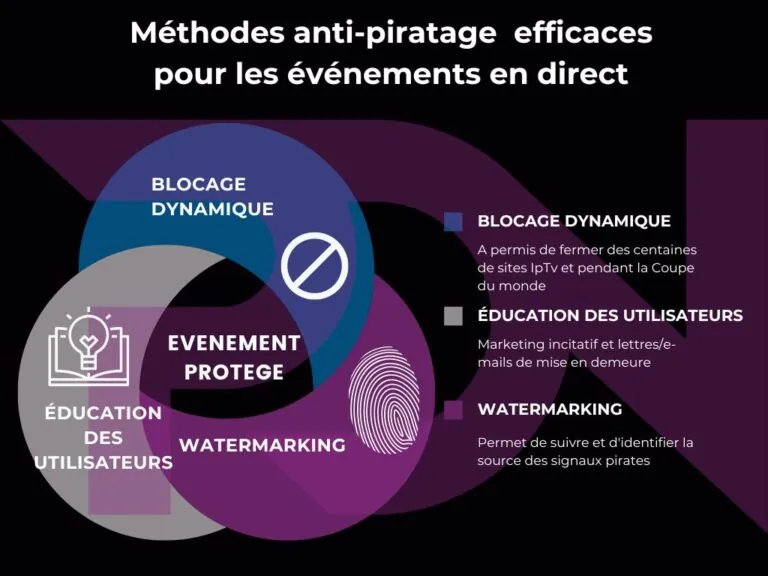
The methods used remain conventional (monitoring, takedown and watermarking or dynamic blocking), but what stood out during the World Cup was a combination of several of these methods, as well as extensive cooperation with the authorities – particularly regarding dynamic blocking.
Watermarking
With this technique, it is indeed possible to trace back to the account that bought the original content, and to deactivate easily and quickly any account used to illegally rebroadcast live sporting events, which cuts off the source used by pirates and prevents them from redistributing it.
Watermarking plays an important role in the fight against sports piracy. The accounts used can be quickly identified and immediate action can be taken, such as blocking the account and taking legal action.
However, not all types of watermarking give the same results when it comes to fighting live event piracy. Server-side watermarking in particular relies on long video captures – so the event may already be over by the time the pirate account is identified.
Client-side watermarking is much more likely to give a quick result – which is necessary for live sports. Only a few seconds of video need to be captured to extract it. At present, it is the only type of watermarking available on the market that makes it possible to fight piracy while the match is still going on.
However, several sports broadcasters, including beIN, have said that watermarking alone was not enough; this is why, at the 2022 World Cup, unlike previous tournaments, dynamic blocking was developed in many countries, allowing a real-time response, including against mirror sites, which is the whole point of this technique.

The value of dynamic blocking during the 2022 World Cup
The major difficulty with conventional judicial blocking measures is that rights holders must update the original court decision – which concerns one or more sites – with additional website addresses (and the new domain names used) or IP addresses so that internet service providers can block them. For a long time, mirror sites easily escaped blocking orders.
One of the solutions – widely explored during the World Cup in Qatar – allows greater flexibility in court decisions, and it is now possible in many countries to quickly update blocking measures as illegal sites migrate.
In practical terms, this means that the court can – in addition to blocking the illicit sites named in the original decision – order the blocking of the domain names and, where applicable, IP addresses identified by rights holders and reported to internet service providers (and/or search engines), thereby updating the decision in real time without going back before the judge.
Making end users accountable
There is also the question of taking into account the role played by internet users – active participants in these services.
In some countries, measures that complement or replace penalties include promoting the legal offer and developing awareness and communication tools aimed at the general public or at specific groups.
Measures aimed at making end users accountable have historically fallen into two trends: warning systems and formal notice solutions, which can coexist in the same country. However, for the moment these measures have given few results and have partly been abandoned.
What seems more effective is the systematic redirection of users to legal content (whitehat marketing); users will often go looking for the content that is easiest to find. Making pirated content less accessible while promoting legal content and offering an attractive deal therefore currently seems to be the best way to encourage users to watch live sports legally.
Join us in April for our next article on the role of YouTube in piracy.
In the meantime, if you have content to protect – a film, series, music album or live event – don't hesitate to contact one of our account managers; we will be happy to help, so that you can take back control of your revenue!