Cloud and Cybersecurity (1)

We have seen many times that no anti-piracy method is foolproof. But many voices have been raised, including that of video game publisher Sony when it launched its online gaming platform, literally calling “cloud gaming” a solution that could “eliminate piracy” in its patent application, citing as examples World of Warcraft and the low level of its revenue losses due to piracy, as well as other massively multiplayer games.
The cloud has now been part of our lives for several years.
This omnipresence of the cloud obviously has consequences for cybersecurity. While the cloud carries risks, some also see it as a solution that could, in the medium term, make piracy almost obsolete.
AgencePDN gets pirated content removed: see our solutions by sector.
In this first part, we will therefore look at what exactly the cloud is, and what threats it can pose to cybersecurity in general, before turning to its influence on piracy, and more specifically the piracy of software and video games, in the second part of our article.
What is the cloud?
“Cloud computing” is a model of IT service delivery that provides access to resources: servers, databases, networks, software and storage over the internet. Instead of having its own servers or physical IT infrastructure, an organization can use cloud services provided by third-party providers to meet its data processing, storage and management needs.
What are the benefits of cloud computing?
- The cloud is scalable: Cloud resources can easily be adjusted to demand. Companies can quickly scale capacity up or down according to their needs, which allows more efficient resource management.
- Remote access: users can access resources from anywhere with an internet connection, which supports mobility and collaboration; this is a particularly useful feature in recent years, since remote work has grown since the Covid-19 pandemic
- Pay for actual use of the services: cloud services are often billed according to actual consumption. This allows companies to save on infrastructure costs and adapt to seasonal variations.
- Centralized management: the cloud brings everything together in one place, which allows more efficient management
- Resilience: cloud services are generally designed to be resilient and always available, which reduces downtime.
- Automatic updates: cloud service providers generally handle software maintenance and updates, which guarantees access to the latest features and security patches.
Cloud risks for cybersecurity
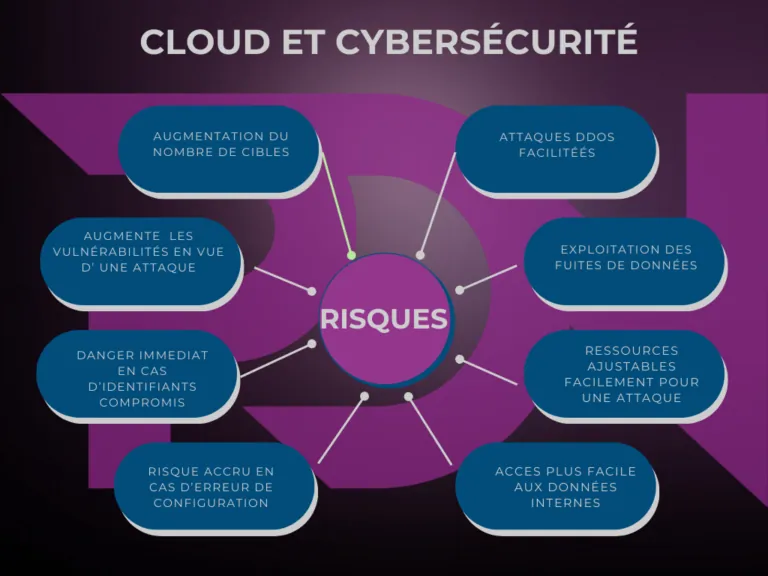
But clearly, this accessibility of data over the internet inevitably increases cybersecurity risks. What are they?
More potential targets
Cloud computing has allowed companies to store and manage huge amounts of data and applications in cloud infrastructures. This has created new potential targets for attackers, because a great deal of sensitive data is now accessible over the internet.
Distributed denial-of-service (DDoS) attacks
Cloud services can be used to launch massive DDoS attacks, using the computing and storage power available. Hackers can also rent cloud resources to amplify their attacks and disrupt online services.
Data leaks
Configuration errors in the cloud, such as poor permission management, have led to numerous data leaks. Attackers exploit these vulnerabilities to access sensitive data stored in the cloud.
Scalable computing resources
Cloud infrastructures make it possible to quickly adjust computing resources to demand. This means attackers can also use these capabilities to carry out massive attacks without needing their own costly infrastructure.
Insider threats
Cloud service providers have privileged access to their customers’ data. This creates a potential risk of breach of trust or internal compromise. Hackers could try to infiltrate cloud support teams to gain access to data.
Configuration-dependent security
Security in the cloud depends largely on how services are configured and managed. Configuration errors can unintentionally expose sensitive data, and attackers actively look for such vulnerabilities.
Malicious cryptomining
Attackers often use stolen cloud resources to mine cryptocurrencies, which can be hard for the owners of the resources to detect.
Online storage services
Cloud storage services are often used to store sensitive data, and if login credentials are compromised, the data can be stolen or ransomware can be deployed.
Network traffic analysis
Cloud services offer advanced analytics features. Attackers can use these capabilities to analyze network traffic and identify potential vulnerabilities.
The cloud has therefore both created new opportunities for hackers and introduced additional security challenges. Companies must therefore invest in strong security practices to minimize the risks of hacking in a cloud environment.

However, while the cloud can have a negative impact on cybersecurity, its more specific impact on piracy could well turn out to be positive in the medium term, which we will look at in our next article, in mid-November. In the meantime, if you have content to protect, whether a film, series, book, music album or software, don’t hesitate to contact us, and one of our account managers will be happy to help. We have been pioneers in cybersecurity and intellectual property protection for more than ten years, and we are bound to have a solution to offer you.
Share this article