How AI Helps Strengthen Cybersecurity

We saw in our previous article that artificial intelligence can be used to facilitate cyberattacks in various ways, and that this type of attack is constantly increasing. But AI can also help companies defend themselves, and so keep their networks secure.
What are the benefits of AI in cybersecurity?
AI offers many benefits because of its data processing capabilities, its machine learning and its potential to analyze and anticipate threats.
- Advanced threat detection: AI can analyze vast amounts of data from various sources in real time to identify patterns and anomalies that could indicate potential attacks or malicious behaviour. It can thus help spot advanced threats that are hard to detect with traditional methods.
- Machine learning for adaptation: AI can continuously learn and adapt to new threats and to changes in attacks. This means it can constantly update its detection models without needing constant human intervention.
- Behaviour analysis: AI can monitor the behaviour of users, applications and systems to spot suspicious activity. It can identify actions that deviate from usual behaviour, even if they do not match specific malware signatures.
- Automatic incident response: AI can automate some steps of security incident response. For example, it can isolate parts of the network, block suspicious IP addresses or disable compromised accounts to limit the impact of an ongoing attack.
- Fewer false positives: AI can improve detection accuracy by reducing the number of false positives, that is, incorrect alerts, which can overwhelm security teams.
- Vulnerability analysis: AI can help identify potential vulnerabilities in systems by analyzing configurations, source code and data patterns. This allows security teams to fix flaws before they are exploited.
- Protection against large-scale attacks: AI can quickly detect large-scale distributed attacks, such as DDoS attacks, and take steps to mitigate their impact.
- Log and data management: AI can analyze and sort vast volumes of security logs and incident-related data to identify hidden trends and patterns, making it easier to understand attacks and risks.
- Training security professionals: AI can be used to simulate attack scenarios and training exercises for cybersecurity professionals, which helps them gain experience in incident management.
- Saving time and effort: By automating a number of detection, response and analysis tasks, AI lets security teams focus on more strategic and complex activities, improving the overall effectiveness of cybersecurity.
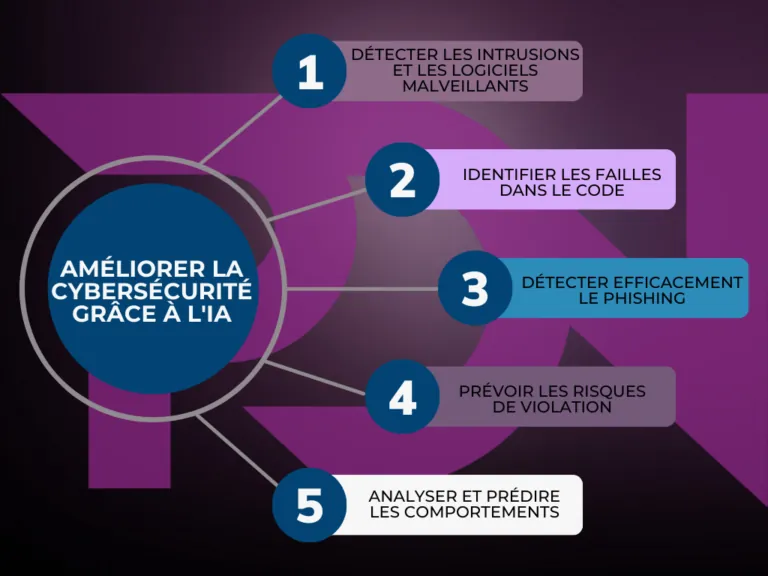
How can AI help strengthen cybersecurity?
AI-assisted systems let security teams detect threats faster and respond to incidents more quickly.
AgencePDN gets pirated content removed: see our solutions by sector.
For example, when malicious activity is detected on a particular IP address or endpoint, AI can automatically and instantly block the user’s access to files.
Here are the main methods AI uses to strengthen network security in companies:
- Detection of threats and anomalies.
- Analysis of identity
- Detection of fraud.
- Management of risks related to compliance and privacy.
- Analysis and categorization of data.
- Search for breach and attack simulations.
- Automation of policies
- Behavioural analysis
While AI can be a powerful tool to strengthen cybersecurity initiatives, it does not replace traditional security approaches. In fact, it works best when used alongside traditional methods: combining AI with authentication or biometric technology, for example, can improve an organization’s defences. One example would be the implementation of password managers: they automate the creation and updating of passwords and advice on the strength of the passwords chosen. Only by combining the two methods can company security truly be maintained in the age of AI.
AI helps defenders detect and identify real threats in this data through pattern recognition in network traffic, malware indicators and users’ behavioural trends.
However, it is important to note that AI is not free of limitations and risks. Adversaries can also use AI techniques to craft sophisticated attacks. Careful and thoughtful use of AI in cybersecurity is therefore essential.
Join us in early October for our next article, in which we will discuss the relationship between the cloud and piracy.
In the meantime, if you have content to protect, whether a film, series, book, music album or software, don’t hesitate to contact us, and one of our account managers will be happy to help you find the formula best suited to your needs. We have been pioneers in cybersecurity and intellectual property protection for more than ten years, and our experts will listen to you so that your intellectual property is protected.
Share this article