Cloud and Cybersecurity (2)

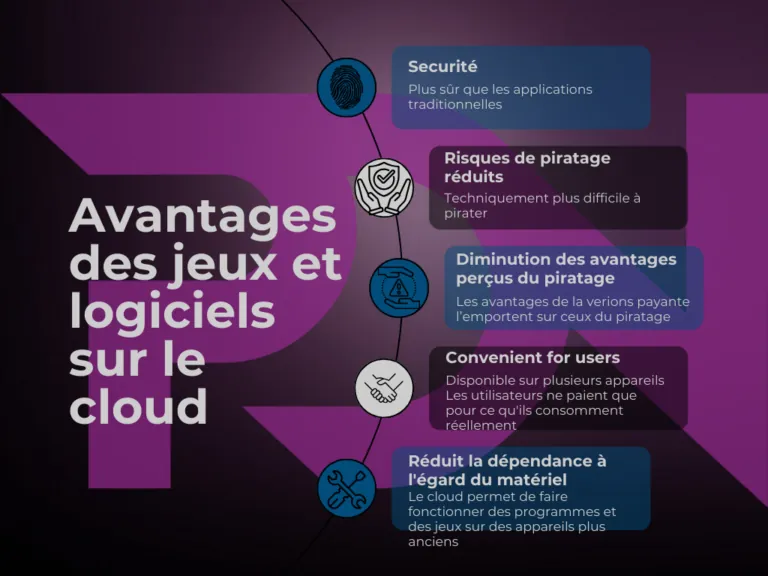
As we saw in our article at the beginning of October, Sony and other publishers have pointed out that the cloud is already a partial solution to piracy, since, as every game and piece of software is stored and run in the cloud, users do not have access to the underlying program code. There is therefore nothing to pirate, and even if the source code is copied, it is difficult or even impossible to run it on one’s own device (PC or console).
Even though pirates always find ways around technical locks (and for games there are other solutions, such as private servers), the cloud does seem to limit game and software piracy. At the same time, streaming services such as Spotify Premium or Netflix are helping to reduce the illegal supply of series and music. Dematerialized services, then, if they are well designed, appear to be a medium-term answer to a large share of piracy.
The evolution of software piracy
In 2013, 43% of the software installed on computers worldwide was not officially licensed, according to the BSA’s Global Software Survey. That figure fell to 39% in 2015 and 37% in 2018, which is the most recent study.
AgencePDN gets pirated content removed: see our solutions by sector.
We must not forget that piracy is also a commercial activity. The larger the gap between what customers are willing to pay for software and the value they think they get from it, the more the software is pirated. The cloud allows regular updates through a subscription system, which also means not having to pay a large sum all at once, which seems more “painless for the user.” It also provides very quick and easy access to customer service, and a better fit for changing needs. Indeed, the cloud makes it possible to access ad hoc modules for a limited time, and so to pay only for what you need at a given moment. Perceived value therefore rises for customers who do not pay a high price for a licence whose features they will use for only one month a year, for example. This type of modular pricing is therefore a strong incentive to acquire the software legally.
However, in some parts of the world (Russia, Eastern Europe and Asia, particularly China), game and software piracy continues to grow. It will therefore have to keep being fought in the traditional way, through search and removal, even if publishers need to think about these monetization policies in the medium and long term.
Cloud service providers: essential partners for anti-piracy
However, we saw in the first part of our article that the cloud could also be a catalyst for piracy. For example, in May 2023, five operators of illegal streaming networks were arrested and convicted in the United Kingdom. They had more than 50,000 customers and resellers and 30 employees, and generated more than £7 million over five years. It was established that a significant number of cloud service providers were involved in the illegal operation.
It is therefore essential to work closely with cloud service providers.
Some providers, such as France’s OVH, have taken matters into their own hands and, since 2021, have begun to work actively to limit the use of their services by pirates. The head of security at OVH cloud says that, after putting a number of processes and protocols in place, they managed to cut the number of IPTV servers hosted by OVH Cloud by 95% by having them shut down, in a single month.
This initiative by the company shows that the role played by hosting providers can be crucial in the fight against piracy.

As with the other components of piracy, the only truly viable solution is to hope that many cloud providers will follow the virtuous path taken by some of them: eliminating illicit uses of their clouds on their own, or at the very least, responding quickly and effectively to requests sent by companies specializing in search and removal. It is this close cooperation between experts, combined with well-thought-out services from software and video game designers, that will make it possible to transform the cloud. From an opportunity offered to pirates, it could then become a real tool for fighting piracy, and ultimately for reducing it drastically.
We will continue this reflection on the role of web players in piracy in November; we will look at the web giants, notably X, Google and Facebook, to study their role, and sometimes their passivity, in the fight against the distribution of illegal content online. In the meantime, if you have a film, a series, software or an ebook to protect, don’t hesitate to call on our services by contacting one of our account managers. PDN has been a pioneer in cybersecurity and anti-piracy for more than ten years, and we are bound to have a solution to help you. Happy reading, and see you soon!