Big Tech and the Fight Against Piracy (2)

We saw in our previous article that some companies well known to internet users, such as Google and Plex, were making notable efforts to fight piracy and its effects; however, the picture is darker for other companies that are much less scrupulous about it and are the poor performers; in the second part of this article, we will therefore see how (and partly why) this phenomenon shows up.
Advertising
A report commissioned by the Digital Citizens Alliance shows that large companies invest heavily in advertising on pirate sites; this advertising reportedly brings in more than a billion dollars a year for sites whose only reason for being is to make copyright-infringing content available.
Studying 6,194 pirate sites and 884 piracy apps, the report estimates that pirate sites generated more than $1.08 billion in advertising revenue and apps more than $259 million in addition. Most of this revenue is said to be concentrated on five major sites, and one in four ads on these sites is said to come from one of the big Big Tech players.
AgencePDN gets this kind of content removed: see our Fraudulent ads service.
In its report, the Digital Citizens Alliance directly calls out companies such as Amazon, Facebook and … Google.
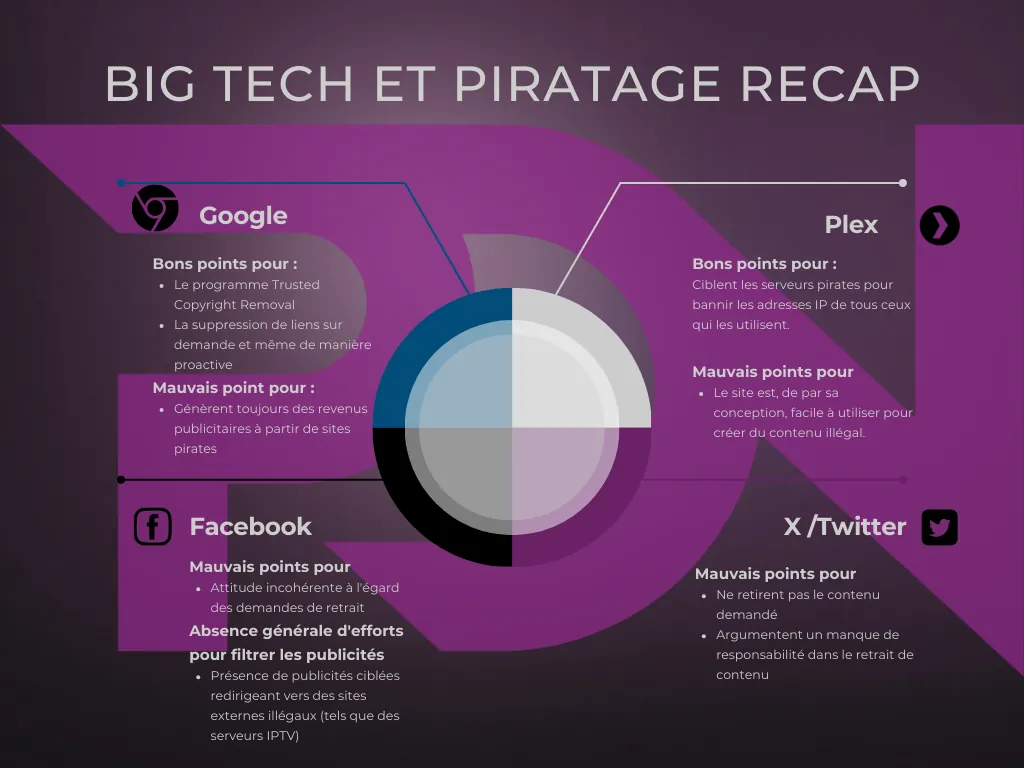
Indeed, while Google, as we saw in our previous article, is making noted efforts to have pirate links removed from its search engine, that does not stop the company from advertising on pirate sites – notably for its Google CDN and AdTech services – and therefore earning revenue from them.

Facebook: no willingness to organize and invest?
As for Facebook’s attitude, we can only speculate, but it is clear that the company suffers from malfunctions, a lack of staff, or a lack of will when it comes to removing Marketplace listings that infringe copyright. We work daily with clients on mandates asking us to search for and request the removal of illegal listings.
Facebook’s responses vary and are often problematic: while it removes most listings without question, one of the following situations regularly occurs:
- No reaction at all and therefore no removal
- Questioning our right to make this request, even though all the legal documents proving the validity of our mandate are attached
- Questioning the validity of the removal; according to Facebook, the illicit listings advertise our clients, so the platform sees no reason to have them removed
- Technical malfunctions that simply prevent the request from being sent.
We almost always manage, in the end, to have the listings concerned removed, but at the cost of a great loss of time and energy, even though the situations are simple and fairly obvious.
It should be noted that there is clearly no single point of contact, which makes it impossible to build a relationship of trust and cooperation, even though the requests concern listings that are almost identical each time, and the requests are made in the same way. It is therefore clear that piracy is a problem that does not unduly concern the company, and that the response varies depending on the employee’s willingness to read the submitted forms properly and check the links. Since these problems are recurring and more marked during holiday periods (summer, Christmas), it seems clear that the staff concerned receive no training on this point.
X/Twitter and music
On Elon Musk’s platform, we had already reported that a photo agency was in court for failing to remove thousands of copyrighted photos. But this problem now extends to music. Indeed, several companies such as Universal, Sony and EMI have filed a complaint against X Corp, alleging that the company is directly liable for the sharing of content that infringes their copyrights.
Elon Musk’s company is defending itself and claims the complaint is inadmissible, arguing in particular that it had no intent; however, there is indeed a feature for streaming music, and users are encouraged to upload content directly from the platform; music piracy is thus directly facilitated by the company, and we have already seen that the removal of content on X/Twitter was problematic, with Twitter notably sheltering behind the shield of freedom of expression. According to the labels’ lawyers, intent would not be essential; material contribution (easily shown given the existence of the tools mentioned above and X Corp’s inability or unwillingness to remove the disputed content), combined with the existence of financial benefits, would be enough to establish the infringement. And the financial benefits are undeniable: the platform’s advertising revenue is boosted by this illicit content.
The legal battle ahead will therefore be interesting in terms of how the infringement is characterized, and the case law that results will no doubt help define more clearly the exact responsibility of these major players in this kind of situation. Perhaps they will no longer be able to excuse themselves so easily by hiding behind the screen of lack of intent.
So, while we cannot clearly state that some of the Big Tech players actively facilitate piracy, their passivity gives free rein to many behaviours that infringe copyright. Removing content always means a loss of revenue for platforms, whereas publishing listings that infringe copyright does not directly penalize them.
At PDN we have more than 10 years of experience in removing illicit content. Do not hesitate to call on us if you have content on illicit sites or on platforms such as Marketplace or Twitter; our team will be happy to help in the best way possible.
Join us in December for a month devoted to the social costs of piracy; happy reading and see you soon!
Share this article