The pirates of the dark web

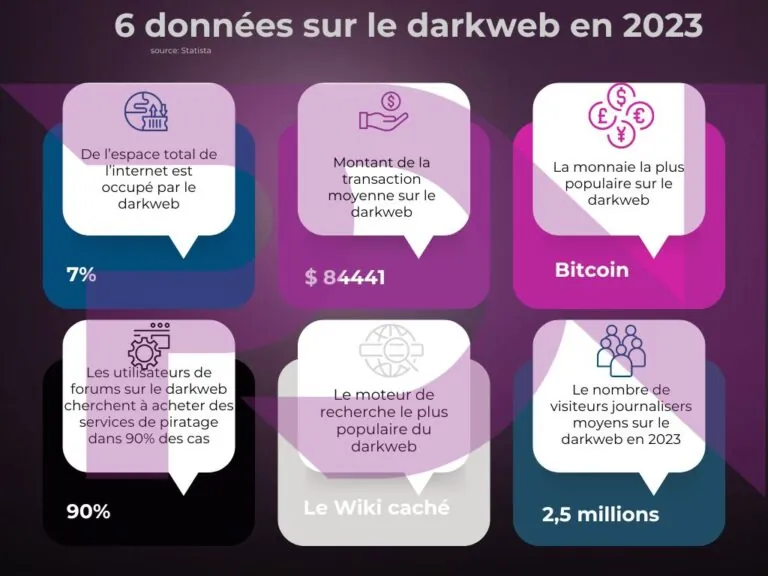
In the first part of our article, we saw what the dark web is and what it is used for; but what is its role in the spread of piracy? That is what we will try to find out today. Since you can literally buy and sell anything there, it obviously also serves as a marketplace for hacking tools and services.
For example, it is possible to buy malware kits and security vulnerability exploits there, and even rent botnets to carry out DDoS attacks.
User anonymity
One of the main attractions of the Dark Web is its infrastructure, specially designed to guarantee anonymity. Hackers can operate there without fear of being easily identified. IP addresses are masked, and communications are encrypted through protocols like Tor, which considerably complicates the work of law enforcement. Anonymity encourages criminal activity and allows hackers to exchange information or sell stolen data without risking revealing their identity.
AgencePDN gets pirated content removed: see our solutions by sector.
Marketplaces and exchanges dedicated to hacking
As we have already said, the Dark Web is well known for hosting many clandestine marketplaces where hacking tools and services are for sale.
For example, Exploit Kits, which contain software for exploiting security vulnerabilities in systems, are easily accessible for payment in cryptocurrencies. These kits allow people without advanced technical skills to carry out sophisticated cyberattacks.
In addition, hacking-on-demand services are available. Cybercriminals offer to hack online accounts, steal data or carry out attacks against companies on behalf of anonymous clients.
Hacker forums and communities, where information is exchanged, hacking techniques are shared and “training” is offered to newcomers, are also available on the dark web. This creates an environment where hacking becomes more accessible, even for those without in-depth technical skills.
The consequences of dark web-related hacking
This particular environment has consequences for businesses, individuals, and even states.
One of the most significant consequences of the Dark Web for hacking is the massive proliferation of stolen data, and in particular company databases. When a company or online service is hacked, the stolen personal information (such as names, email addresses, phone numbers, passwords, and sometimes even financial information) often ends up on the Dark Web. These databases are then put up for sale, and buyers can use this information to commit other crimes, such as identity theft or financial fraud.
Hackers also exploit this data for massive phishing campaigns, in which fraudulent emails are sent to victims to trick them into providing even more sensitive information, or to infect their devices with malware.
Data theft through leaks and hacks also has devastating consequences for individuals. Once on the Dark Web, personal information can be used to commit large-scale fraud, such as opening bank accounts under false identities or making fraudulent online purchases. Individuals who fall victim to these hacks often face significant complications in restoring their identity, their finances and their reputation. In addition, cybercriminals target individuals directly with phishing attacks or digital harassment.
Finally, the Dark Web plays a crucial role in the escalation of state-sponsored cyberattacks. Nation-states are increasingly turning to cyberespionage and digital attacks to obtain sensitive information about other governments or strategic companies.
The economy of stolen data
The Dark Web has also created a true economy of stolen data. The illegal trade in this information is organized around anonymous sales platforms, where prices vary according to the quality and quantity of the data offered. For example, credit card numbers, PayPal account credentials and passport information are traded at very high prices, making this trade a very lucrative sector for cybercriminals.
Businesses are the main targets of hackers operating on the Dark Web. Cybercriminals exploit system vulnerabilities to steal sensitive data. Ransomware attacks have become common.
The economic repercussions of such attacks are enormous. Companies often have to pay ransoms, repair damaged systems, and deal with legal or public relations costs to restore customer trust. This trend is only increasing because of the growing number of activities facilitated by the Dark Web.

Technical and legal responses
Governments and security agencies around the world are working to fight criminal activity on the Dark Web. Operations such as Operation Onymous, carried out by Europol and the FBI in 2014, led to the shutdown of several illegal marketplaces and the arrest of their administrators. However, despite these efforts, the decentralized and anonymous nature of the Dark Web makes such operations complex and often temporary. For this reason, no large-scale operation has taken place since.
Faced with the increase in cyberattacks, cybersecurity has become a booming sector. Companies are investing heavily in protection solutions such as firewalls, intrusion detection systems and vulnerability management programs. Cybersecurity professionals are on the front line to counter cybercriminals, thwart hacking attempts and strengthen digital defence systems.
Advanced technologies such as artificial intelligence and machine learning are used to detect and neutralize threats in real time. In addition, practices such as cyber hygiene, where employees are trained to spot phishing attempts or use secure passwords, help strengthen defences against hacking.
Governments are increasingly adopting laws to fight cybercrime. For example, the European Union has put in place the General Data Protection Regulation (GDPR), which imposes severe penalties in the event of a personal data leak. In the United States, laws such as the Computer Fraud and Abuse Act make it possible to prosecute cybercriminals.
However, regulating the Dark Web and hacking is a difficult task. The cross-border nature of these crimes complicates coordination among national authorities, while the anonymity of criminals makes identifying and arresting them hard.
Future prospects
The Dark Web and digital hacking will continue to evolve as technology advances. Artificial intelligence and machine learning are already being used to improve hacking techniques, but also to strengthen digital defences. The development of blockchain and cryptocurrencies offers new opportunities for criminals while providing new ways to trace illicit transactions.
Join us in November for our series of articles on blockchain. In the meantime, if you have a film, series, software or ebook to protect, don't hesitate to call on our services by contacting one of our account managers; PDN has been a pioneer in cybersecurity and anti-piracy for more than ten years, and we certainly have a solution to help you. Happy reading and see you soon!
Share this article