Blockchain: History and Principles

Blockchain is often presented as a revolutionary technology, synonymous with security, transparency and decentralization. Originally used to support cryptocurrency transactions, such as Bitcoin, blockchain has since expanded into various fields, such as finance, logistics, health care and even real estate. However, while blockchain is an asset for data security, it also attracts the attention of cybercriminals and hackers. Indeed, some aspects of blockchain, although secure, are exploited for malicious purposes, which has led to a rise in attacks and new forms of hacking associated with it.

History of Blockchain
- 1991: The beginnings
Researchers Stuart Haber and W. Scott Stornetta introduced the concept of a chain of blocks to secure documents with timestamps in order to prevent the tampering of digital records. - 2008: Bitcoin and the first blockchain
Blockchain truly emerged in 2008 with Satoshi Nakamoto’s famous white paper, Bitcoin: A Peer-to-Peer Electronic Cash System. Nakamoto describes Bitcoin as a digital currency based on blockchain technology to allow financial transactions without an intermediary (banks). - 2014: Other uses of blockchain appear
From 2014, developers and companies began to see the potential of blockchain beyond Bitcoin. The creation of Ethereum by Vitalik Buterin in 2015 made it possible to develop smart contracts, which allow automatic transactions when certain conditions are met. - 2020: Mass adoption and regulation
Blockchain now attracts the attention of companies and governments. Many applications emerge in fields such as finance, logistics, health care, and even the arts (NFTs). Regulations are also emerging to govern cryptocurrencies and the use of blockchains in different sectors.
Understanding Blockchain
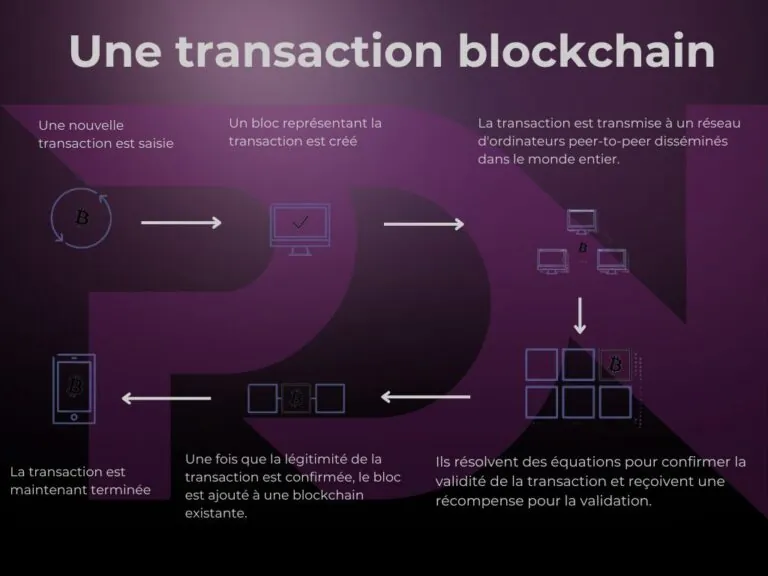
Blockchain is built on the principles of transparency, immutability and decentralization. It makes it possible to store data in a decentralized and immutable way, that is, with no possibility of modifying or deleting it once it has been recorded. Information is recorded in the form of “blocks” linked together chronologically to form a chain of blocks. The blocks of data are linked to each other by cryptographic hashes, which guarantees the integrity of the recorded information. Once a transaction has been validated and added to a block, it can no longer be modified or deleted without altering the whole chain, which makes tampering extremely difficult.
A blockchain is, in a way, a digital ledger distributed and shared among several users. A blockchain is made up of programs called scripts that carry out the tasks usually performed in a database: entering and accessing information, recording it and storing it somewhere. A blockchain is distributed, which means that several copies are stored on many machines and that they must all match in order to be valid. The information stored is as follows:
AgencePDN gets pirated content removed: see our solutions by sector.
- The data of the transactions (or other information depending on the use),
- A timestamp to mark the moment the data was added,
- A unique identifier in the form of a “hash” that ensures the integrity and security of the data.
The four types of blockchain networks
Public blockchain networks
Public blockchains require no permission and allow anyone to join. All members of the blockchain have the same rights to read, edit and validate. People mainly use public blockchains to trade and mine cryptocurrencies such as Bitcoin, Ethereum and Litecoin.
Private blockchain networks
A single organization controls private blockchains, also called managed blockchains. It determines who can be a member and what rights they have in the network. Private blockchains are only partly decentralized because they have access restrictions. Ripple, a digital currency exchange network for businesses, is an example of a private blockchain.
Hybrid blockchain networks
Hybrid blockchains combine elements of private and public networks. Companies can set up private, permission-based systems alongside a public system. In this way, they control access to specific data stored in the blockchain while keeping the rest of the data public. They use smart contracts to let public members verify whether private transactions have been carried out. For example, hybrid blockchains can allow public access to digital currency while keeping the currency held by banks private.
Consortium blockchain networks
A group of organizations governs consortium blockchain networks. The preselected organizations share responsibility for maintaining the blockchain and determining data access rights. Sectors in which many organizations have common goals and benefit from shared responsibility often prefer consortium blockchain networks. For example, the Global Shipping Business Network Consortium is a not-for-profit blockchain consortium that aims to digitize the shipping industry and increase collaboration among operators in the maritime industry.
The main strengths of blockchain are:
- Decentralization: It removes the need for a central authority.
- Security: Data is immutable and resistant to tampering.
- Transparency: Transactions are visible to all participants.
- Automation: Thanks to smart contracts, certain actions can be programmed.
Join us in mid-November for the rest of our article. We will see that blockchain can influence both piracy and anti-piracy. In the meantime, if you have a film, a series, software or an ebook to protect, don’t hesitate to call on our services by contacting one of our account managers. PDN has been a pioneer in cybersecurity and anti-piracy for more than ten years, and we are bound to have a solution to help you. Happy reading, and see you soon!
Share this article