Human Error: The Weak Link in Cybersecurity

Despite technological advances and massive investment in IT protection solutions, security breaches persist. The main reason is that one of the most vulnerable elements in this field remains the human being: handling errors, carelessness and social engineering are all factors that make ordinary digital users responsible for many security breaches. This month, we will therefore explore why humans are often considered the weak link in cybersecurity and how this vulnerability can be reduced.
Human nature and unintentional mistakes
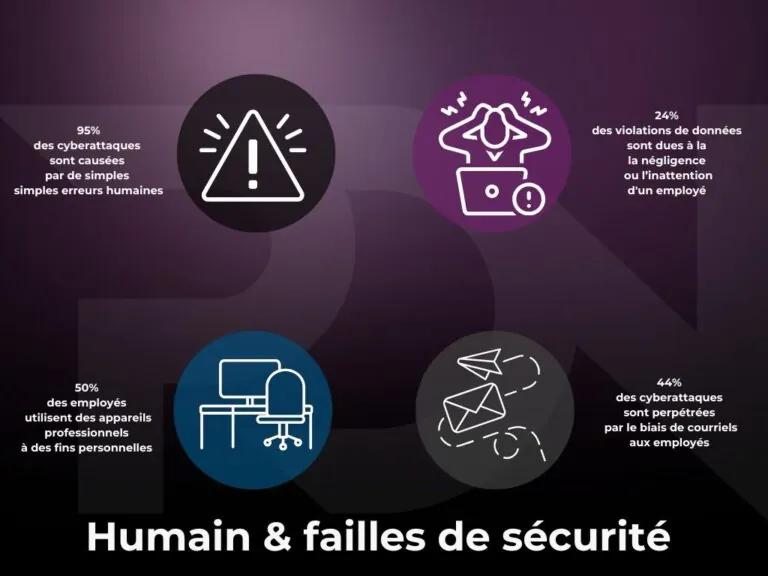
Human error is one of the main causes of cybersecurity incidents. According to many studies, between 80% and 95% of successful cyberattacks exploit human rather than technical weaknesses.
Carelessness and lack of awareness
Many users do not grasp the scale of the risks linked to cyberattacks. A weak password, a connection to an unprotected public Wi-Fi network or a failure to install security updates are all behaviours that compromise the safety of systems, even though the user has no malicious intent.
AgencePDN gets pirated content removed: see our solutions by sector.
- One of the most common forms of carelessness is reusing passwords across several accounts. When a password is compromised on one platform, it can then be used to access other critical services, exposing sensitive information. In addition, some users don't bother to check the authenticity of the emails and links they receive, which makes phishing attacks easier.
- Failing to update software and operating systems is also a major weakness. Cybercriminals regularly exploit known vulnerabilities, and not applying security patches in a timely manner increases the risk of intrusion. Likewise, using removable media (USB drives, external hard drives, and even mobile phone chargers from unknown sources) without checking them first can introduce malware into computer systems.
- An aggravating factor is users' excessive trust in technological devices. Many think that antivirus software and firewalls are enough to protect them, when constant vigilance and secure practices are essential to reduce risk. Awareness and ongoing training are therefore crucial to combat this careless behaviour and strengthen cybersecurity.

“Shadow IT”
Employees often bypass the cybersecurity rules imposed by their company, out of convenience or lack of resources. Using unapproved software or unsecured personal devices is a common practice that exposes companies to major risks.
Shadow IT refers to all the IT tools, software and services used without the approval of an organization's IT department: use of unsecured online storage platforms, consumer messaging apps or unapproved collaboration tools. These practices, often motivated by a search for productivity and flexibility, introduce considerable security weaknesses.
- On one hand, unapproved software and applications do not necessarily comply with the company's cybersecurity standards. They may contain unpatched vulnerabilities, make data leaks easier or be exploited by attackers.
- On the other hand, the lack of centralized control prevents cybersecurity teams from monitoring access, detecting anomalies and applying patches when needed.
- Using personal devices (phones, tablets, computers) for work tasks further increases these risks. These devices do not always get the required security updates, and their access to the company's internal systems can serve as a way in for cybercriminals.
To reduce the impact of Shadow IT, it is crucial to educate employees about the dangers it represents, to put clear control policies in place and to offer secure alternatives that meet employees' needs.
Social engineering: an often underestimated threat
Cybercriminals exploit human psychology to obtain confidential information. This approach, known as social engineering, is often more effective than purely technical attacks.
Phishing and its variants
Phishing remains one of the most common attack methods. It consists of tricking users into believing they are dealing with a trusted organization (bank, government agency, company) in order to steal sensitive information.
Among the variants of phishing are:
- Spear-phishing: a targeted attack aimed at a specific person using personalized information, which makes the fraud more believable.
- Vishing (voice phishing): using the telephone to extract sensitive information by posing as an official service.
- Smishing (SMS phishing): sending fraudulent messages containing malicious links or requests for confidential information.
Exploiting human emotions
Cybercriminals know how to play on human psychology to manipulate their victims. Commonly used techniques include:
- Fear: alarming messages (a fake security alert, a threat to close an account) push users to act without thinking.
- Urgency: a time-limited offer or an immediate request for action pushes victims to provide information without checking its authenticity.
- Curiosity: a fake document, an intriguing video or a supposedly confidential file may contain malware.
- Authority: cybercriminals pose as authority figures (CEO, technical support, government agencies) to intimidate their targets and obtain sensitive information.
Pretexting and manipulation attacks
Social engineering also relies on elaborate scenarios to manipulate victims. Among the most commonly used techniques:
- Baiting: leaving infected items (USB drives, CDs) in a public place in the hope that someone will use them, thereby introducing malware onto their computer.
- Quid pro quo: offering a fake service in exchange for sensitive information, for example a fake technical support agent asking for remote access.
- Insider attack: a trusted employee or contractor is corrupted into disclosing confidential information.
Join us in mid-March for the rest of our article. In the meantime, if you have a film, a series, software or an ebook to protect, don't hesitate to call on our services by contacting one of our account managers; PDN has been a pioneer in cybersecurity and anti-piracy for more than ten years, and we are bound to have a solution to help you. Happy reading, and see you soon!
Share this article