IPTV: How to Fight Back?

In our last article, we saw that illegal IPTV promises to give you on-demand access to hundreds of TV channels, thousands of films, series and sporting events, for a few dozen euros a year. In this second part, we look more closely at how IPTV works, and at the possible solutions for fighting its harms.
What Is IPTV's Business Model?
Some customers subscribed to television services resell and retransmit their communication signal to the operators of illegal IPTV services. The latter then create bundles to resell access to individuals.
The system is accessible with a simple Android box (which costs around fifty euros) similar to the standard boxes sold by TV providers, an APK file and a USB key. Subscriptions can be found on Alibaba, eBay, a Reddit thread, a Facebook group or directly through a Google search.
AgencePDN gets this kind of content removed: see our Illegal IPTV service.
Very often, the promise of these subscriptions is HD quality, and therefore equivalent to what legal subscriptions offer.

A Subtle Technical Flaw
The process is given away by a very slight delay, of about thirty seconds. What these pirates offer is therefore “almost live.” The pirates are in fact exploiting a flaw in the HDCP (High-bandwidth Digital Content Protection) protection system. They have to capture the stream, recompress it and rebroadcast it, which explains this slight delay.
Despite the difficulty of assessing the exact size of an illegal market, the number of sites keeps growing and, according to this European Union report it is estimated that about 4% of Europeans (13 million) use illegal IPTV services. This number is reportedly rising steadily. In 2018, according to the same report, this pirate activity generated 1 billion in revenue — that much lost income for legal services.
It is therefore essential to find solutions to fight this relatively new form of piracy, since the already substantial loss of revenue for rights holders will only increase if no action is taken.
What Tools Are There to Fight It?
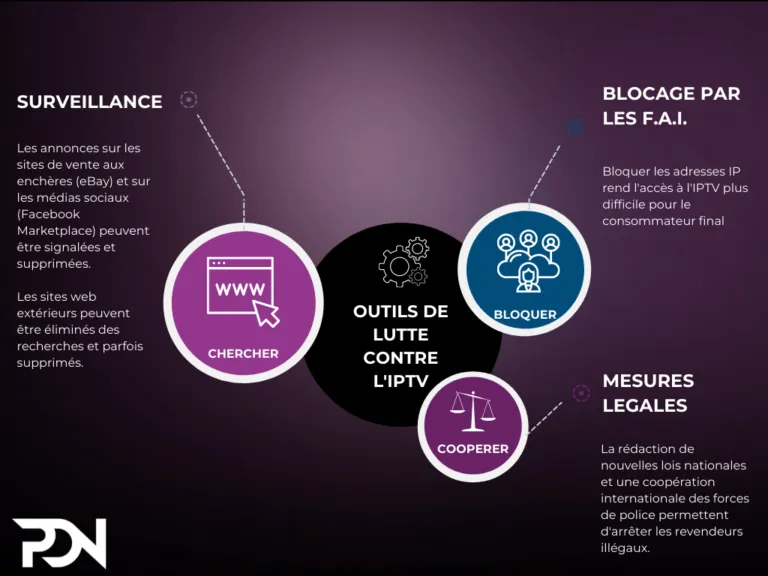
Monitoring Resale Sites
To fight illegal IPTV, the first step is above all to monitor the networks and to have illegal listings removed from the various resale sites (eBay, Facebook Marketplace, Kijiji, Aliexpress…).
The auction site eBay is an interesting case, since the site did not filter its listings as recently as a year ago, but now does. The scale of the illegal IPTV resale market on the site, the various legal characterizations of counterfeiting and intellectual property infringement made in Europe for illegal IPTV (whether for the resale of boxes or the resale of subscriptions), and the very many takedown notices made by anti-piracy companies have contributed to much more thorough upstream filtering, and to a noticeable decrease in the listings actually published.
Here, it is indeed a convergence between the work of anti-piracy companies and the evolution of legislation that has made it possible to reduce the online offer on eBay.
This observation, however, holds only for eBay – offers continue to abound on the other sites – notably Facebook's Marketplace – mentioned above.
Blocking by Internet Service Providers
Another solution, first applied in Europe but now beginning to arrive across the Atlantic as well, is IP address blocking by ISPs.
Of course, many internet users know that there are ways to get around blocks, and that the big IPTV networks simply change IP address regularly. But not everyone necessarily knows which tools make it possible to ignore such a measure, or where to find information about an address change.
Moreover, the value of this multiplication of blocks, laws, trials and case law also lies in helping the public understand just how illegal the resale, use and possession of IPTV equipment and services is, and how much it harms legal sellers.
Coordinated Police Action
Furthermore, even though blocking access is a measure that helps limit the spread of IPTV, arresting the heads of the big networks remains essential.
In Europe, for example, Europol coordinates regular takedowns by allowing national police forces to cooperate with one another, by facilitating the exchange of information and by coordinating the financial side of the investigation.
- In June 2020, Europol helped dismantle a large network that illegally distributed content in Europe, Asia and the Middle East. The pirates were illegally broadcasting more than 40,000 TV channels, films and series. The network's leaders were arrested simultaneously in 4 countries (Spain, Germany, Sweden and Denmark) and €4.8 million was seized.
- In November 2020, Eurojust, the European Union Agency for Criminal Justice Cooperation, announced that it had seized 5,500 servers spread across several countries and belonging to a network that allegedly generated €10.7 million.
This type of action also helps educate the public.
It is therefore the combination of upstream work by cybersecurity companies (spotting and removing listings), lawmakers, ISPs and police forces that will ultimately reduce the economic impact of illegal IPTV.
If you have problems with the illegal resale and distribution of your IPTV services, don't hesitate to contact us. We are a leader in Canada in the fight against piracy, and have more than 10 years of experience in the field. We can help you fight illicit IPTV content, worldwide.
Join us in June for our next article, in which we will see how your marketing spending sometimes directly benefits pirates.