Inside the Minds of Hackers (1)

The terms “pirates” or “hackers” often evoke stereotyped images drawn from the collective imagination or from media portrayals. We picture them as computer geniuses, frantically tapping on a keyboard in a dark room, lit only by the pale glow of a screen scrolling with neon-green lines of code, their face barely visible under the hood of a black sweatshirt. But beyond this caricature, who really are these mysterious individuals who operate in the dark corners of cyberspace? What are their true motivations? What methods do they use to break into systems that are often well protected? And above all, is there an ethic specific to these activities, which so often sit at the edge of legality?
These questions raise many issues, and the answer is far from simple. Hackers are not a homogeneous group: some operate for personal gain or espionage, others out of challenge or ideology. The latter, sometimes called “hacktivists,” use their skills to defend causes or denounce injustices. Their activities cover a broad spectrum, from simply testing a website for vulnerabilities to massive cyberattacks paralyzing entire institutions.
Gathering reliable information about them is obviously a challenge, since their actions are often hidden behind a veil of anonymity. Yet sources exist, such as anonymous interviews, rare testimonies, or exchanges on specialized forums and often-encrypted discussion platforms. These scraps of information make it possible, with caution, to paint a more nuanced portrait of these players in the digital world.
AgencePDN gets pirated content removed: see our solutions by sector.
In this two-part article, we will try to explore this universe by analyzing their profile, their motivations, their methods and the perception they themselves hold of their acts. Far from the clichés, we will seek to understand who is really hiding behind these enigmatic figures of the cyberworld.
A Typology of Hackers
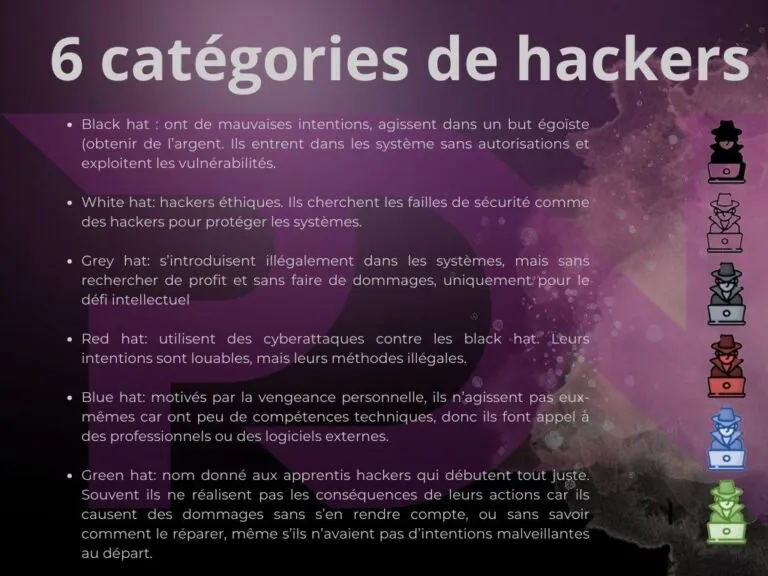
- “Black hat” hackers: These hackers act in complete illegality and seek above all to profit personally from their actions. Often motivated by financial gain or malicious intent, they specialize in activities such as stealing sensitive data (such as banking information or credentials), financial fraud, or ransomware attacks, which consist of blocking access to a victim’s data or systems until a ransom is paid. They work in the shadows, using advanced techniques to cover their tracks, and sometimes operate within genuine organized criminal networks.
- “White hat” hackers: In contrast to “black hats,” “white hat” hackers use their skills for ethical and legal purposes. These cybersecurity experts play a crucial role in protecting computer systems by detecting and fixing flaws before ill-intentioned individuals can exploit them. They generally work for companies, governments or organizations seeking to secure their infrastructure. Interestingly, some of them were once illegal hackers who had succeeded in breaking into protected systems. Spotted for their talents, they were recruited by the victims of their intrusions and chose to put their skills at the service of security, rather than continue illicit activities.
- “Grey hat” hackers: These hackers occupy an ambiguous position, on the border between legality and illegality. They may, for example, identify a security flaw in a system without having obtained prior authorization to access it. Although they often report these vulnerabilities to the system’s owners, they sometimes act without respecting legal frameworks. Unlike “black hats,” they do not necessarily seek financial gain or to cause damage, but their unauthorized approach can put them on illegal ground. Their approach often raises ethical questions: are their actions justified if they improve overall security, even while breaking rules?
- Hacktivists: These hackers have a mainly ideological motivation, whether political, social or environmental. They use hacking as a weapon of activism, often to denounce injustices, expose abuses or promote a cause. Unlike purely criminal hackers, their goal is not personal profit but spreading a message or raising public awareness. The Anonymous collective is probably the most emblematic example of hacktivism, known for spectacular actions targeting governments, multinationals or organizations seen as oppressive. These digital activists frequently operate on the dark web and use sophisticated techniques to protect their anonymity while organizing large-scale campaigns.
- Organized cybercriminals: These structured groups operate like true mafias in the digital world. Equipped with considerable resources, they coordinate complex operations involving teams specialized in various branches of hacking: creating malware, exploiting flaws, laundering money, and so on. Their goal is mainly financial, and they are responsible for the most devastating cyberattacks, such as the theft of millions of personal records, the hacking of large companies and attacks on critical infrastructure. These organizations often operate internationally, making them particularly hard for authorities to track down.
Varied and Complex Motivations
- The quest for power and recognition: Many hackers are driven by the intellectual challenge of hacking. For some, recognition within the hacker community is a form of gratification.
- Financial profit: Organized cybercriminals often seek to monetize their activities by stealing data, launching ransomware attacks or running online scams.
- Idealism or activism: Hacktivists, for example, fight for causes close to their hearts. Whether it is denouncing an injustice or promoting government transparency, their goal often goes beyond simple personal gain.
- Revenge or resentment: Some hackers, disillusioned by a personal or professional experience, may act out of revenge.
- Curiosity and love of a challenge: Some digital pirates, particularly the youngest, are motivated by the simple desire to understand and test the limits of computer systems.
- The impossibility of stopping: hacking can become a kind of addiction. As technologies evolve to counter them, hackers want to get the upper hand and break the new technological barriers; possible financial success makes it hard to quit, as in any criminal activity. Moreover, the isolation caused by this kind of activity, and being in contact almost exclusively with other hackers, leads to a desocialization that makes returning to a normal life particularly difficult, even when you see your colleagues being caught one by one by the authorities.
A Look at Their Psychological Environment
The psychology of a digital pirate is often marked by a fascination with complex systems and security mechanisms. Here are some common traits frequently found:
- Analytical intelligence: Hackers often have an exceptional ability to solve problems and think creatively.
- A strong sense of community: Although they often work alone, many digital pirates are part of forums or groups where they exchange ideas and techniques.
- A tendency toward introspection: Many hackers spend long hours alone in front of a computer, which encourages deep reflection on their actions and their impact.
- Contempt for established rules: Pirates, especially black hats and hacktivists, often have a rebellious attitude toward authorities or institutions and see themselves as anarchists or the like.

An Ambivalent Ethic
The question of ethics is central to understanding digital pirates. Even though they do not hesitate to break the law, some hackers, even non-hacktivists, have a certain code of honour. For example, some refuse to attack health systems or charitable organizations. Hacktivists, for their part, often justify their illegal actions by invoking a “greater good,” such as the fight against corruption or the protection of individual freedoms. Hackers often think they form a community apart, with more perspective than others on how the world works, and therefore feel entitled to steer it in a certain direction. Their understanding and superior intelligence would give them that right.
Join us in mid-February for the continuation of our article, which will look at a very specific category of cybercriminals: specialists in IPTV networks. In the meantime, if you have a film, a series, software or an ebook to protect, don’t hesitate to call on our services by contacting one of our account managers; PDN has been a pioneer in cybersecurity and anti-piracy for more than ten years, and we are bound to have a solution to help you. Happy reading, and see you soon!
Share this article