Identity Theft on Social Media (Part 1)

The message in your inbox is disturbing. You don’t remember talking to this person, let alone promising to hire them, but the things they say to you are upsetting. Suspecting yet another social media scam, you don’t reply, you block them and you forget the incident.
But a few days later, it’s someone else who contacts you. This time, it’s a customer accusing you of not having sent her the digital product she bought from your Instagram page.
When you bring up the situation with those around you, one of your friends, an aspiring influencer and avid social media user, quickly comes across the fake account of your business. She understood right away what was happening to you, because she had already been a victim of the same phenomenon.
AgencePDN gets this kind of content removed: see our Fraudulent ads service.
Identity theft is indeed relatively common on social media, and it affects all kinds of circles, from politics (Nebraska Democratic Party chair Jane Kleeb had to deal with a fake Twitter account during part of her campaign) to influencers such as YouTuber Jeffree Star.
The situation is far from anecdotal. Between 4% and 10% of social media accounts are reportedly intended solely for identity theft. In 2019, for example, Facebook had 2.2 billion illegitimate accounts removed. Identity theft on social media is a real invasion of your privacy. On a fake Facebook or Instagram account you can find photos of your family, but it is also a real risk for your brand or business.
What is identity theft?
It is a social media account, opened by an unknown person, that bears your name (your real name or your brand’s) or a very similar name. It often uses your profile photo, even your personal photos, your graphic identity, your logo or any other identifying element of you or your business.
This account tries to pass itself off as you, speaking in your name, for a fraudulent or malicious purpose.
What are the practices?
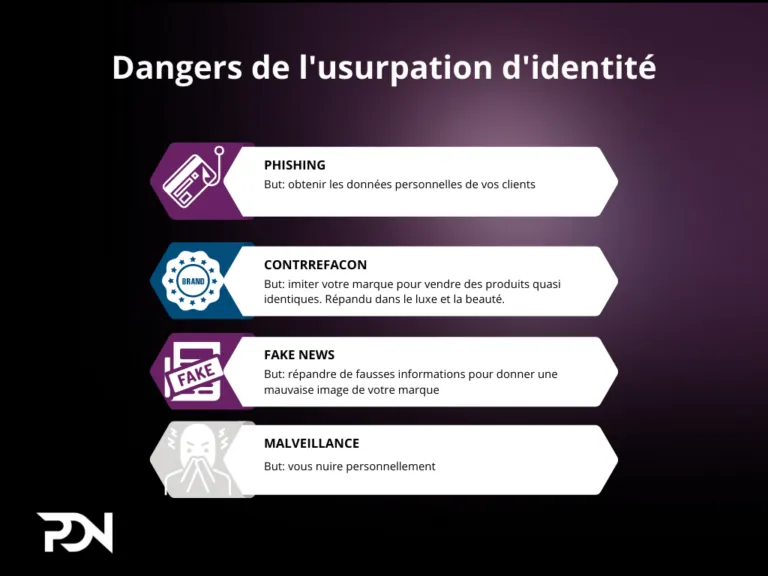
The practices all essentially aim to collect information, often with the goal of reselling it.
Phishing
By impersonating a brand, the impostor will try to obtain personal information and sensitive data about customers (passwords, even banking details).
Counterfeiting
This is a fake page that tries to deceive consumers by selling them counterfeit copies of a well-known brand. This practice affects only large companies with an established brand image, and especially the luxury and beauty sectors.
Fake news
These are accounts that claim to be the official page of politicians or celebrities, and claim to speak in their name in order to give a bad image of a public figure.
Malice
These pages come from people you know in your private life, or from strangers who hate your online “persona.” These users create accounts to attribute hateful or stupid remarks to you, or even to depict you in sexual situations in order to humiliate you and stir up hatred against you.
Who is affected?
The most affected brands are those with a very large presence on social media (many followers, a lot of content, many advertising campaigns) and those with none or very little. The identity of a brand without an official account is indeed very easy to steal.
How to recognize a fake page?
Fake pages generally use the same graphic identity as a brand’s official account.
Most of the time they imitate a company’s customer service or recruitment department. The goal is to take advantage of Google searches such as “company name + support” or “company name + recruitment.” Their number of followers can sometimes be an indicator of fraud, but not always, as some of these pages have more followers than the official account they copy!
Fake pages appear and disappear continuously. Indeed, the first days of activity of a fraudulent account are the most fruitful: the fake account has not yet been identified as such, and that is when it can be particularly aggressive. The speed at which removed fake accounts reappear is proportional to the size and popularity of the company.
Join us again very soon for the rest of our article. We will look at the social networks most affected and the steps to take if you are a victim of identity theft.