Cryptocurrencies and Piracy: Between Anonymity and Risk

At the outset, cryptocurrencies were a dream: an autonomous financial system, free from banks, states and borders. More transparency, more freedom, more privacy. Fifteen years after Bitcoin appeared, those promises are still there, but their echo has darkened.
What was billed as a revolution for the world’s citizens has also become the weapon of choice of modern cybercrime. Ransomware, scams, money laundering: crypto-assets are now at the heart of the financial mechanics of most cyberattacks.
It is therefore necessary to understand how they work, how they are misused… and where the grey areas lie. In this first part, we will look at why cryptocurrencies attract cybercriminals so much, which mechanisms they use, and where the real risks lie for businesses.
AgencePDN gets pirated content removed: see our solutions by sector.
The Myth of Anonymity: A Gift to Hackers?
Contrary to popular belief, cryptocurrencies are not completely anonymous. On most blockchains (such as Bitcoin’s or Ethereum’s), transactions are public, visible to everyone, and kept indefinitely. But that does not mean they are identifiable. Each transaction is tied to a cryptographic address, not to a real identity. And that is exactly the problem: this pseudonymity leaves the field wide open to cybercriminals, who use tools to cover their tracks even further – mixers, tumblers, conversions between currencies, even purchases by proxy.
In 2023, according to Chainalysis, more than $24 billion in crypto-assets were identified as linked to criminal activity.
Most often, these funds pass through anonymous wallets, then through offshore platforms before being laundered into the real economy. Security teams and law enforcement then have to trace chains that are complex and deliberately opaque.
The Winning Combination for Cybercriminals
Cryptocurrencies combine several very attractive key advantages:
- Decentralization: there is no central authority to block a transaction or freeze an account.
- Global accessibility: an Internet connection is all it takes to create a wallet.
- Irreversible payments: once sent, a crypto transfer cannot be cancelled.
- Easy conversion: dozens of platforms let you convert Bitcoin into dollars or euros… sometimes without adequate controls.
Ransomware and Crypto
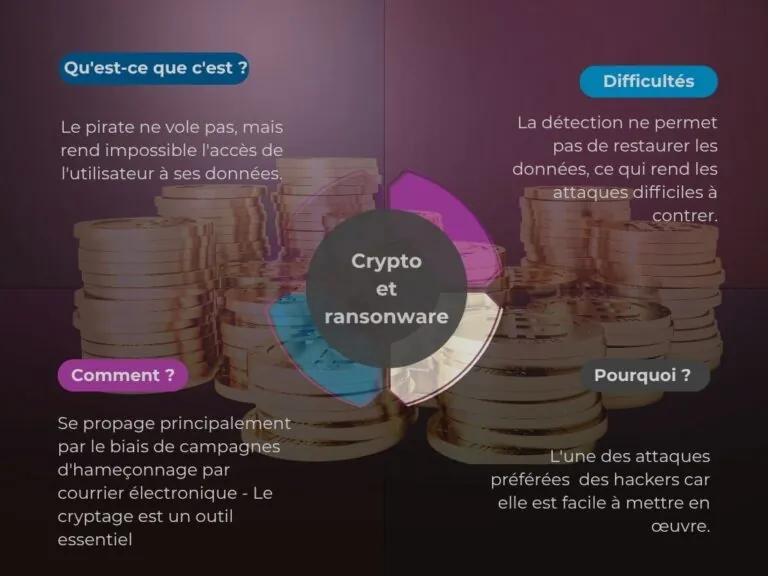
Where cryptocurrencies truly become a problem for businesses is in their use as a currency of extortion. Ransomware attacks have exploded in recent years, hitting hospitals, municipalities, small and medium-sized businesses and multinationals alike. Ransomware groups now demand ransoms in Bitcoin or Monero almost systematically. The modus operandi is now well honed: attack, encryption of data, a ransom note with a QR code for payment, then a threat of disclosure.
Crypto suits these attacks because it ticks every box:
- It makes it possible to demand a fast, global payment with no banking channel.
- It is hard to trace once mixed or converted.
- It gives hackers a clean and fast way out, minimizing the risk of identification.
With the rise of “double extortion” – encryption plus a threat to publish sensitive data – companies face a dilemma: pay and risk finding themselves on the wrong side of the law… or refuse and see their data exposed.
What About Compliance?
This is not only a technical matter. It is also a major legal issue. When a company falls victim to ransomware, it almost always lands in the red zone with respect to data protection regulations.
- In Europe: the GDPR
The General Data Protection Regulation (GDPR) imposes a notification obligation in the event of a leak or unauthorized access to personal data. In a double-extortion case, a company that paid without reporting is exposed to penalties of up to 4% of its worldwide revenue.
- In North America: CCPA and PIPEDA
In the United States, several laws exist depending on the state. The most advanced is the California Consumer Privacy Act (CCPA), which imposes obligations similar to those of the GDPR on companies operating in California.
In Canada, the Personal Information Protection and Electronic Documents Act (PIPEDA) governs the handling of personal data, and it too imposes transparency obligations in the event of a breach.
In every case, regulators are clear: paying a ransom does not relieve you of your security and privacy responsibilities. And in some countries, paying sanctioned groups can even be treated as terrorist financing.
Exchange Platforms: Critical and Vulnerable Points
In a cybercriminal’s hands, a crypto ransom has value only once it is converted into real currency. That is where exchange platforms come in, linking the digital world to the traditional financial system.
Regulated platforms, such as Coinbase or Kraken, apply strict KYC (Know Your Customer) procedures. But many smaller exchanges, often based in offshore jurisdictions, are much laxer – even completely opaque.
Some services even offer built-in anonymization features: automatic address changes, converters to privacy-focused cryptocurrencies, and so on. As long as global regulation is not harmonized, these gaps will remain heavily exploited.
It is sometimes forgotten, but crypto platforms are also prime targets for cyberattacks. Theft of funds, ransomware, compromised customer data… There is no shortage of examples:
- Mt. Gox (2014): more than $460 million stolen.
- Ronin Network (2022): $625 million siphoned off by a North Korean group.
- FTX (2022): a spectacular collapse amid internal fraud.
So even when a company chooses to pay a ransom, there is no guarantee that the funds will reach their destination… or that confidentiality will be preserved.

Cryptocurrencies are not bad in themselves. They are neutral by nature, and their potential is immense in finance, traceability, smart contracts…
But their decentralized and pseudonymous structure also makes them powerful tools for cybercriminals. And for businesses, this calls for a new level of vigilance:
- Know how crypto-assets are misused in order to anticipate threats.
- Identify weak signals (blackmail attempts, suspicious payments, data leaks).
Put response strategies in place suited to attacks involving cryptocurrencies.
In the second part of this article, we will explore traceability tools and best practices in the event of an attack. In the meantime, if you have a film, a series, software or an ebook to protect, don’t hesitate to call on our services by contacting one of our account managers; PDN has been a pioneer in cybersecurity and anti-piracy for more than ten years, and we are bound to have a solution to help you. Happy reading, and see you soon!
Share this article