Consumer Tracking (1)

UFC-Que Choisir, a French consumer association, published a study to mark European Data Protection Day on January 25, showing the scale of the data collection carried out by commercial companies.
The study reveals that an average consumer who visits about ten websites a day is tracked more than 4,000 times. That data is then shared with more than 1,000 third parties. Of course, most consumers don't know it, or don't give it much thought when they surf the web.
But what is data tracking and what is it for?
AgencePDN gets pirated content removed: see our solutions by sector.
Tracking in a nutshell
Tracking means monitoring and following every move a user makes in order to adapt marketing policy, generally through cookies installed on sites. It is a legal practice, and the user is usually told that they can accept or refuse cookies, which gives them an illusion of choice. Every click, every piece of information entered in a form, and also browsing history data is then shared with the site being visited, and often resold to third parties who often resell it themselves to other commercial sites. Tracking also makes it possible to know which site you came from, and which site you go to next.
If it's free, you're the product: social networks (X, Instagram, Facebook) are among those most affected by this practice. Of course, apps on mobile devices use it too.

Secrets brought into the open
Using this information, data brokers are able to build a very precise advertising profile of each consumer. The goal, obviously, is to target ads and encourage overconsumption. Advertising is part of most people's daily lives, but what sets these apart from ordinary ads is how extremely precise they are: political preferences, gambling or opioid dependence, health problems, depression … no behaviour, even behaviour that internet users think is secret, is secret from these data brokers.
The idea, more or less openly admitted? Exploit psychological weaknesses to encourage buying by creating marketing needs that the user didn't know they had. But, based on your data, the perfect ad for you appears on your favourite social network, a driver of overconsumption. That is how, every day, products that internet users didn't think they needed get bought. Normal in a capitalist society? Probably, but this kind of impulse buying shows up in the vast majority of over-indebtedness cases.
It is therefore a commercial practice, a legitimate one, admittedly, but it sits in a grey area, at the edge of good faith, and it is often considered by jurists and fundamental-rights advocates to be unfair and deceptive.
Data collection in practice
Where and how is data collected and shared? Absolutely everywhere, to begin with. A 2022 study shows that in the United States, even on government websites and non-profit organizations, about 7 trackers and 3 third-party cookies are present; the information is also shared with Google Analytics. Data tracking is therefore not even limited to commercial sites and social networks.
Erasing personal data: an illusion
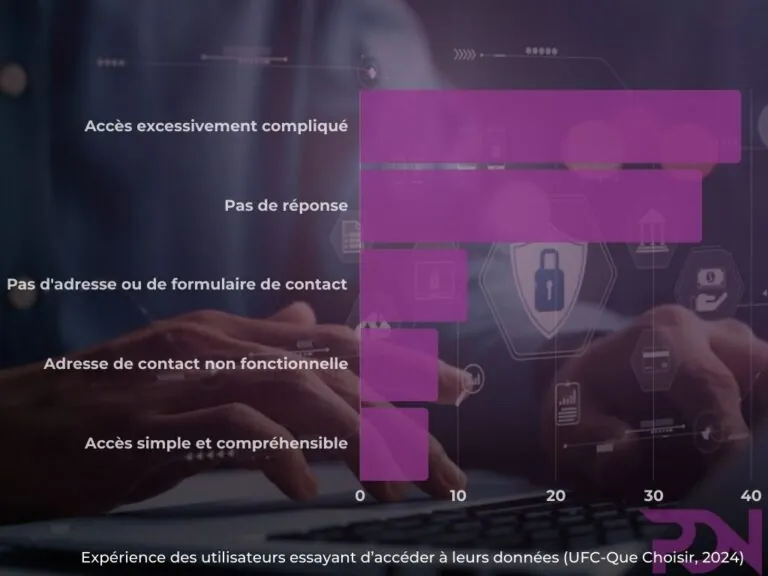
Most consumers, when explicitly confronted with the issue, say they do not want this collection; they believe, however, that the data is not kept or can be erased. The reality? It is much more complicated than that.
Indeed, if you really want to erase your data, you have to go to each commercial site in question and read the terms of use (often long and complex by design) to find the list of third parties with which the site shares your data; you then have to contact those third parties one by one and ask them to respect your rights and erase your data.
The UFC-Que Choisir study shows that more than half of the sites concerned either offer no way to contact them to request this erasure, or simply ignore the requests.
How, then, can we act to improve the transparency of how individuals' data is shared? That is what we will look at in our next article, in mid-March. In the meantime, if you have a film, a series, software or an ebook to protect, don't hesitate to call on our services by contacting one of our account managers; PDN has been a pioneer in cybersecurity and anti-piracy for more than ten years, and we are bound to have a solution to help you. Happy reading, and see you soon!
Share this article