2022: Anti-Piracy Year in Review

2022 is coming to an end, and looking back, we can see that a lot has changed in the world of anti-piracy. Although awareness of the importance of anti-piracy has been building for several years, in 2022 some advances were quite spectacular.
In this two-part review, we will try to analyze certain trends observed in the entertainment industries we work with: film, television, publishing, music and software.
2022 in numbers
All figures in this section come from Statista.com and cover the first three quarters of 2022.
AgencePDN gets pirated content removed: see our solutions by sector.
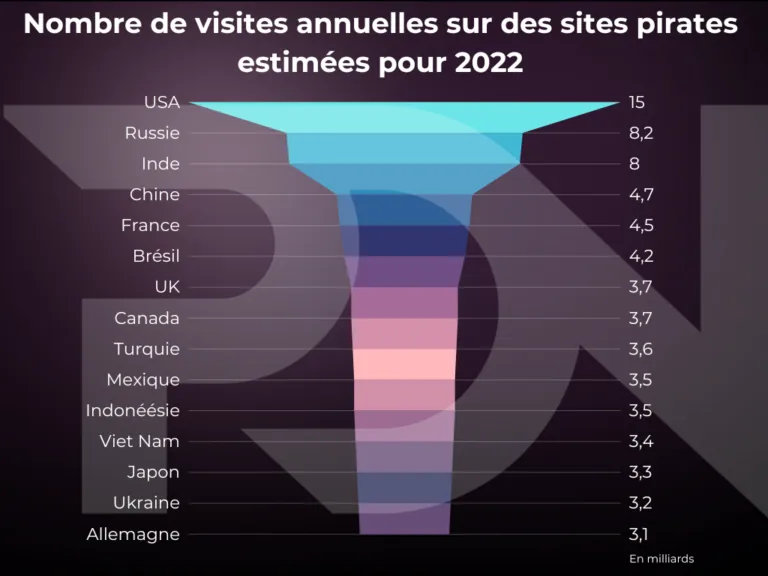
Looking at the geographic breakdown, the United States accounts for 10.9% of piracy over the first three quarters of 2022, with more than 15 billion visits to illegal sites. The most represented European country is France, in fifth place worldwide with 4 billion visits (almost as many as China and its 4.5 billion!), followed by the United Kingdom, in seventh place (3.7 billion), practically tied with Canada, which also has 3.7 billion visits.
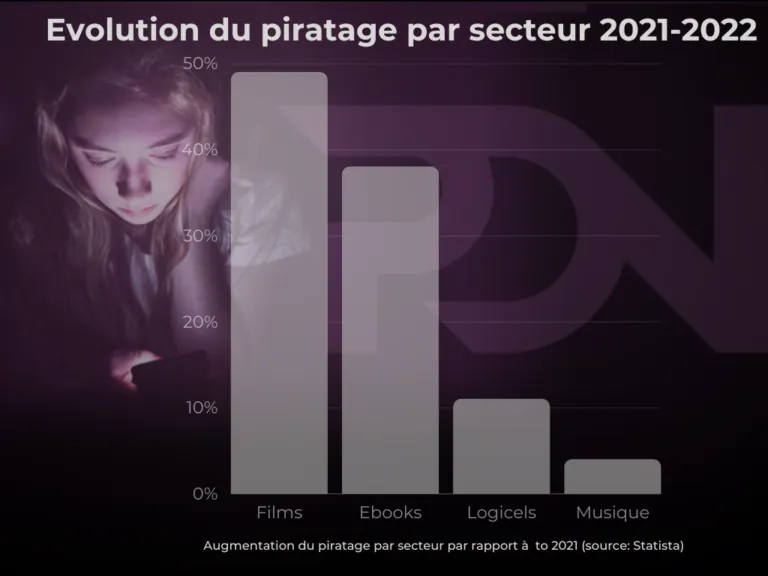
Looking this time at the change in each entertainment sector, we can see that film is where piracy increased the most (almost 50% compared to last year); the second most affected sector is publishing, while music shows the smallest increase (less than 4%). However, piracy increased in every sector.
We will therefore review this year’s key events in each of these industries, to determine how decisive 2022 may prove to be for the sector.
Sporting events and IPTV
In France, the year marks the official start of the new Autorité de régulation de la communication audiovisuelle et numérique, the ARCOM, which describes itself as the “support and driving force of a new public policy by modernizing the exercise of regulation.” One of the authority’s goals for 2022 was to fight the illegal broadcasting of sporting events, which seems to have been a recurring theme in several European countries:
- BeIN Sports was the first company to obtain, in January 2022, a blocking injunction against pirate streaming sites (and their mirrors) under the new French legislation.
- In March and April, authorities in Denmark, the United Kingdom and the Netherlands carried out arrests, blockings, domain seizures and even complete dismantlings of illegal IPTV networks.
- In Ireland, the Premier League obtained an injunction in spring 2022 requiring ISPs to block illegal match streams during the 2022/23 season. The High Court’s decision is the third extension of a groundbreaking 2019 injunction targeting the ISPs Eircom, Sky, Virgin and Vodafone.
- During the summer, BeIN Sports made possible a rather spectacular action: after joining the ACE anti-piracy coalition, the sports broadcaster took part in the shutdown in Egypt of several major sports streaming domains. The Egyptian authorities and ACE worked closely together.
- And finally, in the fall, Spain’s Policía Nacional, with the help of Europol, shut down a major pirate television service that served 500,000 users in Europe. According to the police, the illicit business generated annual profits of more than 3 million euros. Four arrests were made and about a hundred people were charged.
- In Italy, at almost the same time, major operations were also carried out. This time, it was a network serving nearly one million users, also bringing in several million euros a year.
European authorities come to the aid of rights holders
European authorities – whether national or European – were therefore particularly active in assisting rights holders in the fight against illegal IPTV in 2022, carrying out an unprecedented number of operations, notably thanks to the introduction of dynamic blocking in several countries, which makes it possible to react quickly when an online event – mostly a sporting one – is broadcast. It is also the first time that such a large number of arrests have been made, which lets us look to the future with some hope.
In mid-December, in the second part of our article, we will see how the publishing sector evolved over the year, as well as the new role of social networks and online messaging services. In the meantime, if you have content to protect – a film, a series, a music album or a sporting event – do not hesitate to contact one of our account managers, and we will be happy to explain all the ways we can help.